by Jim Forest
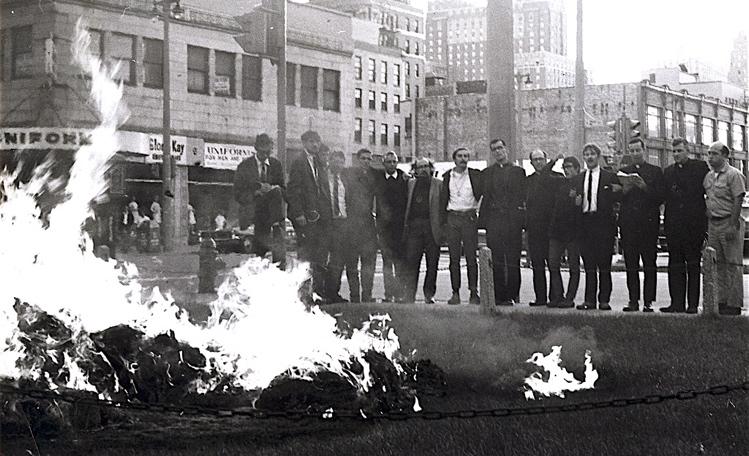
Photograph of the Milwaukee 14 courtesy Jim Forest; details at the end of the article.
Editor’s Preface: Tactics define a protest, whether violent or nonviolent. They have been and are a matter of controversy and heated discussion within movements, as in the recent Occupy. Indeed, some would define nonviolence as a tactic, a definition not accepted by all. In the Catonsville Nine and the Milwaukee 14 protests the burning of draft files was seen by some as a justified means towards ending the Vietnam War, while others such as Dorothy Day and Thomas Merton saw it, at the very least, as a dangerous blurring of the line between violence and nonviolence. Jim Forest is here adding his word to this debate. We have also posted other articles concerning the definition of nonviolent tactics, especially Dorothy Day’s famous article, “Dan Berrigan in Rochester”, and the book review at this link of a recent history of the Catonsville Nine, which quotes Merton’s famous warning. JG
I was one of the Milwaukee 14, a group that burned draft records in 1968. This was the action that followed the Catonsville Nine. The discussion of Plowshares-style property damage and destruction in the November issue of The Catholic Agitator really got me thinking. One of the essential elements in property destruction actions is secrecy. If you tell them you’re coming, they won’t let you in. It’s that simple. The only way around it is to take pains not to be expected. You are obliged to be secretive. There are events in life where secrecy is necessary, even contexts in which life-saving actions are difficult or even impossible unless there is secrecy. For example here in Holland, my home since 1977, you had to be highly secretive about the people you were hiding during the period of German occupation.
Read the rest of this article »
by Ken Butigan
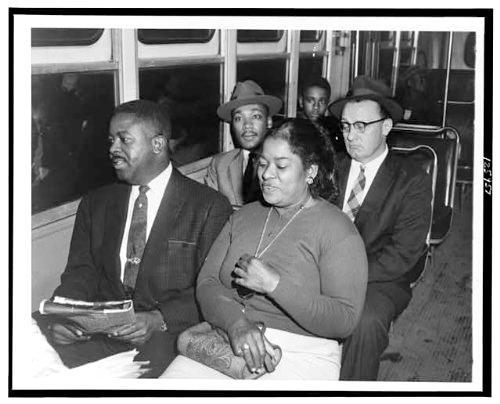
Ralph Abernathy, Martin Luther King, Smiley and unidentified woman, 1956 Bus Boycott; courtesy wagingnonviolence.org
During a visit years ago to the Rock and Roll Hall of Fame in Cleveland, Ohio, I spent a lot of time at an exhibit where you could track the heredity of rock bands. Monitors displayed a family tree detailing what groups had influenced which bands. You could trace how particular acts had inherited, adapted or transformed genres, styles and musical innovations. For example, the Rolling Stones, to the best of my foggy recollection, were influenced by Muddy Waters, Robert Johnson, and Buddy Holly, as well as by Roy Orbison and the Kingston Trio. If even one of those ancestors was out of the mix, the Stones might have sounded very different — or maybe wouldn’t have formed in the first place.
Read the rest of this article »
by Glenn Smiley
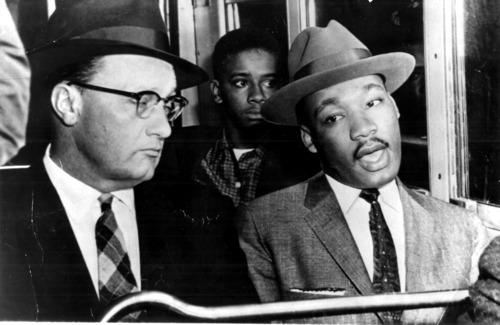
Glenn Smiley riding on a bus with Martin Luther King, Jr., 1956; courtesy wagingnonviolence.org
Editor’s Preface: Rev. Glenn E. Smiley (1910-1993) had made a thorough study of Gandhian nonviolence (satyagraha) while serving as a Methodist minister in Los Angeles. He later worked for the Congress of Racial Equality (CORE) and was national field secretary for the Fellowship of Reconciliation (FOR). During World War II he went to prison for conscientious objection, but he is best remembered for his work with Martin Luther King, Jr. during the Montgomery Bus Boycott. Please also see the note at the end for further information, acknowledgments, and links. JG
From the beginning of humankind’s time on the earth, for about 250,000 years, conflicts between individuals and groups have been settled on the basis of force, domination, or submission. In time, the use of force became more or less institutionalized, and continues to this day in many places.
Read the rest of this article »
by Richard B. Gregg
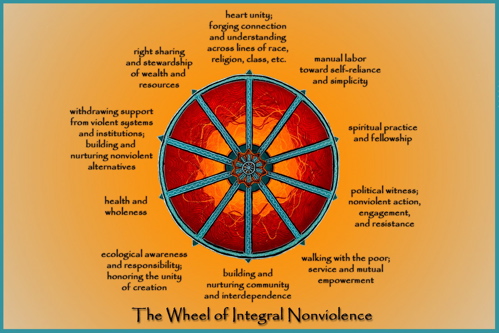
The Wheel of Integral Non-violence is courtesy of chico-peace.org
Editor’s Preface: This 1941 article, with its Foreword by Gandhi, continues our series of important historical documents on the theory and history of Gandhian nonviolence. Gregg here argues for the value of manual labor, as advocated by John Ruskin, and as practiced by Gandhi in his ashrams, where Gregg had lived. Gandhi considered spinning and weaving essential to the routine of a nonviolent community, yet this article is one of the very few to try to explicate this. Please also see the Editor’s Note at the end for more information about Gregg, and please also consult his other article, which we have posted here. JG
Foreword (by M. K. Gandhi): ‘A Discipline for Non-violence’ is a pamphlet written by Mr. Richard B. Gregg for the guidance of those Westerners who endeavour to follow the law of Satyagraha. I use the word advisedly instead of ‘pacifism’. For what passes under the name of pacifism is not the same as Satyagraha. Mr. Gregg is a most diligent and methodical worker. He had first-hand knowledge of Satyagraha, having lived in India and then too for nearly a year in the Sabarmati Ashram. His pamphlet is seasonable and cannot fail to help the Satyagrahis of India. For though the pamphlet is written in a manner attractive for the West, the substance is the same for both the Western and the Eastern Satyagrahi. A cheap edition of the pamphlet is therefore being printed locally for the benefit of Indian readers in the hope that many will make use of it and profit by it. A special responsibility rests upon the shoulders of Indian Satyagrahis, for Mr Gregg has based the pamphlet on his observation of the working of Satyagraha in India. However admirable this guide of Mr. Gregg’s may appear as a well-arranged code, it must fail in its purpose if the Indian experiment fails. (Sevagram, 24-8-1941)
A Discipline for Non-violence
For ages military discipline has won and held men’s faith. However crude, indiscriminate, and brief may be the results of organized violence, the world still has immense respect for its show of firmness and order. Much as we dislike war, when we begin to ask how we can attain justice and peace, we come face to face with this power of the military method. What is the secret of this power? Does it lie merely in men’s fear of violence?
Read the rest of this article »