by Kim Sung-soo
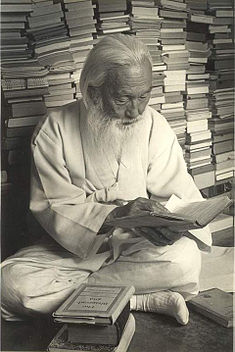
Portrait of Ham Sok-hon courtesy en.wikipedia.org
Ham Sok-hon (1901-1989) was known as the “Gandhi of Korea.” He sought to affirm the identity of Koreans at a time when Korea had fallen prey to Japanese imperialism. Ham believed that discovering one’s identity, especially as a colonized nation, was extremely important as it also determined one’s destiny. Without knowing who you are, it is very difficult to know what to do.
Ham was a civil rights activist when his country was ruled by dictatorial regimes (in both the North and South). Yet, as a maverick thinker, he tried his best to merge diverse religions and ideologies. Although he passed away nearly three decades ago, his legacy still inspires a considerable number of civil rights activists and liberal thinkers in Korea today.
Ham was born in North Korea and died in South Korea. He grew up on a small island in the Yellow Sea at the beginning of the 20th century. His father was a gentle and quiet herbal doctor, while his uncle was a man of action with vigorous Christian faith and a strong sense of patriotism as Korea began to lose her sovereignty to Japan. From an early age, Ham was influenced a great deal by his uncle in terms of merging Christian faith and a spirit of national independence under Japanese oppression.
The March 1 Independence Movement of 1919 was the turning point in Ham’s life, which changed him from a shy boy of eighteen to a courageous young man. From that point on he became very aware of his identity, as well as the identity of his country as a colonized nation. Later, in the 1930s as a history teacher, he began to write what would be Korean history from the oppressed people’s perspective. Because of his view on Korean history, he was imprisoned and suffered greatly at the hands of the Japanese colonial regime. His books, starting with the controversial Korean History in 1948, and the later Queen of Suffering: A Spiritual History of Korea (Seoul, Korea: Friends World Committee for Consultation, 1985) are still recognized as among the most notable books in Korea.
Read the rest of this article »
by M. K. Gandhi
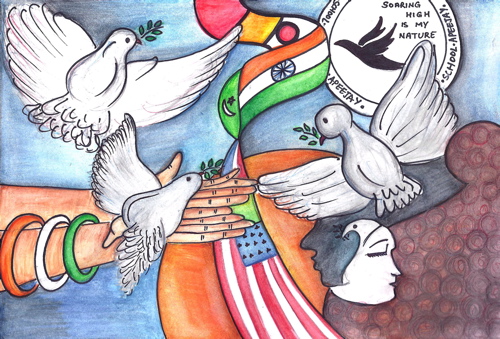
Peace Quilt designed by 9th grader Vidhi Jain, Apeejay School, Pitampura, India; courtesy peacequilt.wordpress.com
Editor’s Preface: We have posted a series of statements by Gandhi that very much address situations and conflicts we currently face, as with his statements on Truth. The “nuclear menace” is much in the news again. These extracts are then being posted in August, the anniversary month of the bombings of Hiroshima and Nagasaki. Please consult the notes at the end for notes, and sources. JG
Has not the atom bomb proved the futility of all violence? (1)
There have been cataclysmic changes in the world. Do I still adhere to my faith in truth and non-violence? Has not the atom bomb exploded that faith? Not only has it not done so, but it has clearly demonstrated to me that truth and non-violence constitute the mightiest force in the world. Before it the atom bomb is of no effect. The two opposing forces are wholly different in kind, the one moral and spiritual, the other physical and material. The one is infinitely superior to the other which by its very nature has an end.
Read the rest of this article »
by George Lakey
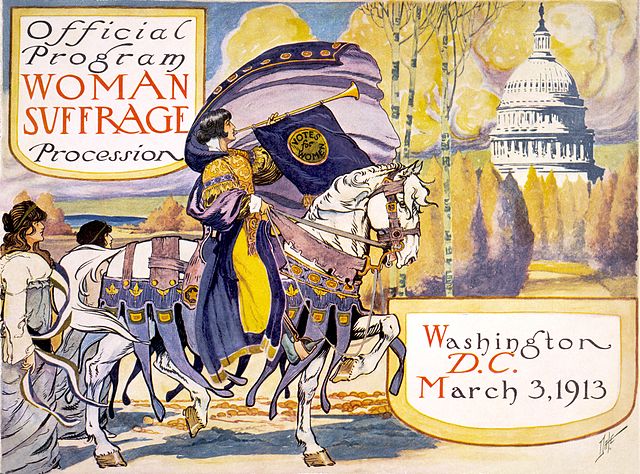
Cover of program for the 1913 National American Women's Suffrage Association march; courtesy Wikipedia.com
Suffragette is a 2015 British film directed by Sarah Gavron. It tells a gripping story drawn from the direct action wing of Britain’s woman suffrage movement. Because it spotlights one tactic — property destruction — the film raises the question of effectiveness. Leader Emmeline Pankhurst’s (1858–1928) argument for escalating with arson and explosions was to hasten their win. Did it?
Read the rest of this article »
by Henry S. L. Polak
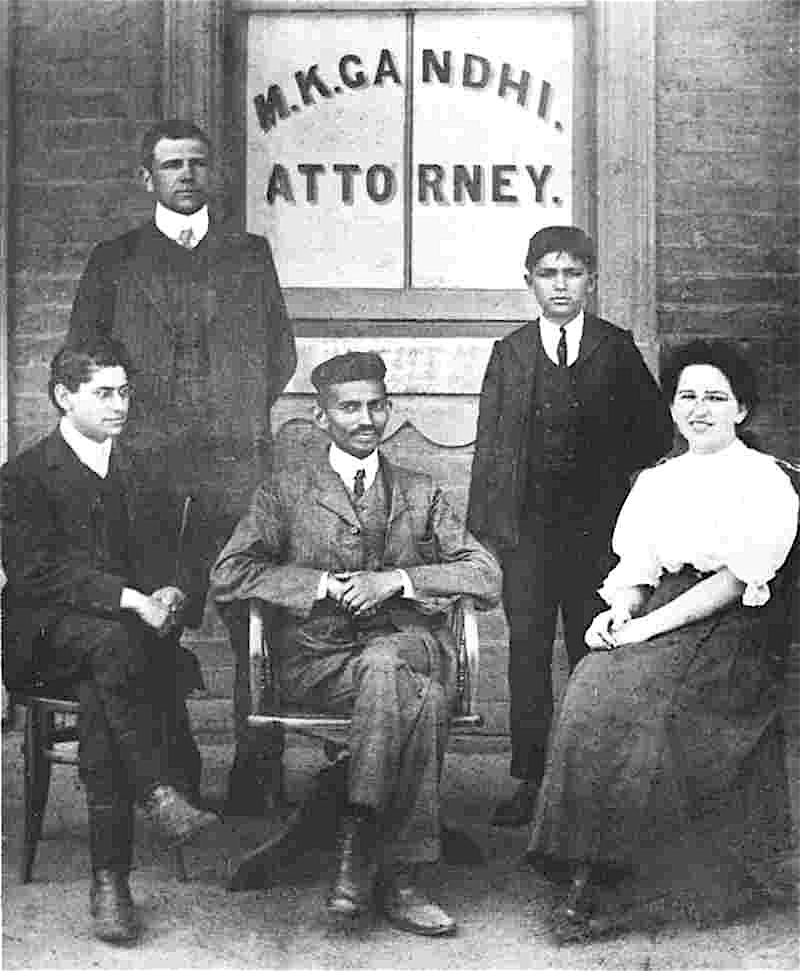
Gandhi in front of his Johannesburg law office, 1905, with Henry Polak (left), Sonia Schlesin; others unidentified.
Editor’s Preface: This 1949 article by Polak is often cited as a primary source of information about Gandhi’s South African years and the events surrounding Gandhi’s coining of the term, “Satyagraha”. Henry S. L. Polak edited Indian Opinion, which he co-founded with Gandhi and is credited with giving Gandhi a copy of Ruskin’s Unto This Last, which Gandhi cites as one of his most important influences. For further biographical and textual information please see the notes at the end. JG
Mahatma Gandhi’s technique of Satyagraha, or, as it was first known, Passive Resistance, had its origins in South Africa. It was in 1906, twelve years after Gandhi’s arrival there, that the flame of Satyagraha began to glow. Until then, the Indian grievances had been dealt with in the usual orthodox ways of petitions, memoranda, addresses, questions in Parliament, public speeches, and so on. But the time had now arrived when, all these having proved fruitless, new and radical methods had to be devised, their consequences considered, and redress thereby determined upon, at whatever cost to those suffering under social, economic, and political disabilities that must no longer be tolerated.
Read the rest of this article »
by Benjamin Naimark-Rowse
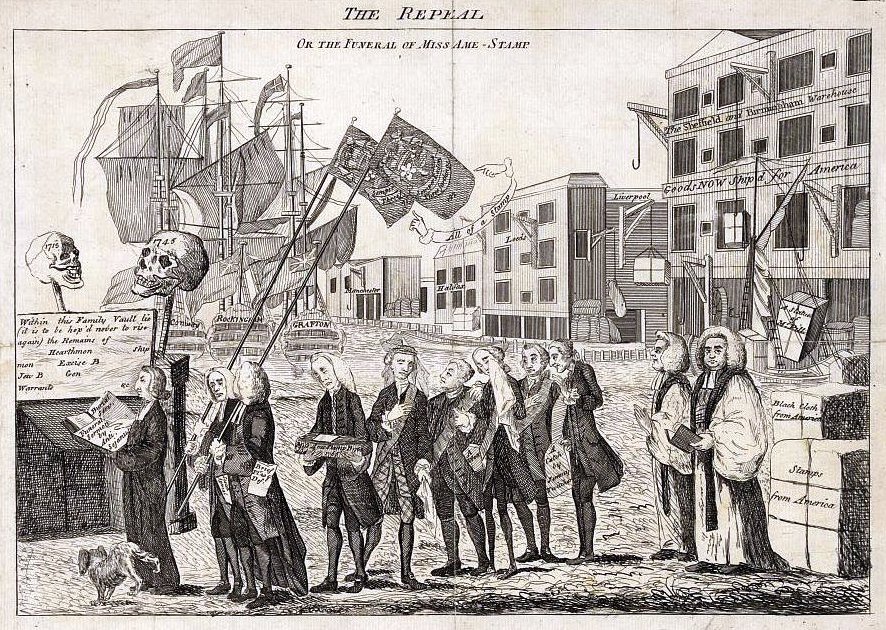
The Stamp Act repeal depicted as a 1765 funeral procession; courtesy commons.wikimedia.org
On the Fourth of July, cities and towns from coast-to-coast across the United States host fireworks, concerts, and parades to celebrate our independence from Britain. Those celebrations will invariably highlight the colonial soldiers who overcame the British. But the lessons we learn of a democracy forged in the crucible of revolutionary war tends to ignore how a decade of nonviolent resistance before the shot-heard-round-the-world (1) shaped the founding of the United States, strengthened our sense of political identity, and laid the foundation of our democracy.
Read the rest of this article »