by David M. Craig
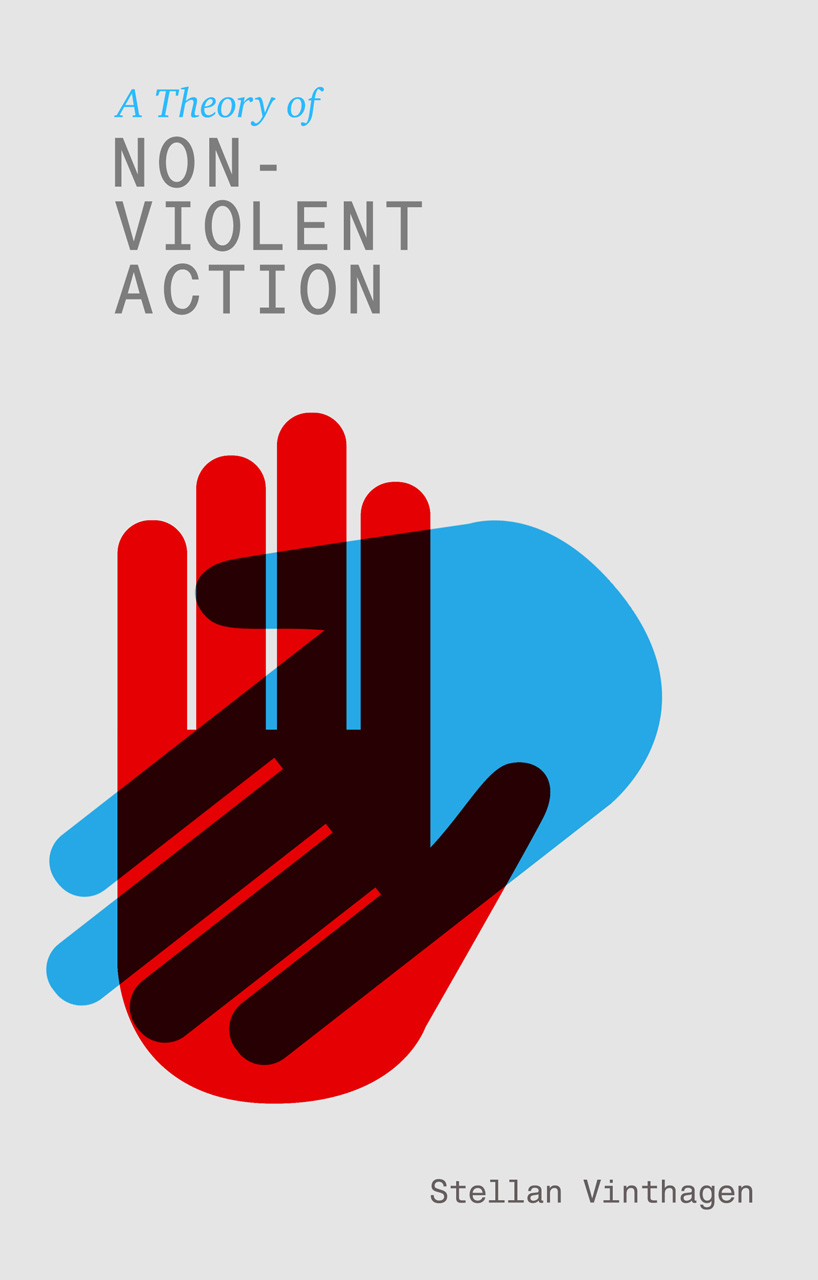
Dustwrapper art courtesy zedbooks.co.uk
Reflecting on the writer’s internal struggle between the sense of futility and the need to persevere, the American author F. Scott Fitzgerald described the “test of a first-rate intelligence [as] the ability to hold two opposed ideas in mind at the same time and still retain the ability to function.” (1) Stellan Vinthagen’s book, A Theory of Nonviolent Action: How Civil Resistance Works (London: Zed Books, 2015), passes a similar judgment on Mohandas Gandhi. Even if Gandhi resisted the “Great Soul” title of Mahatma, his genius included a capacious imagination and experimental creativity that not only embraced opposed ideas, but also put them into action simultaneously. Some of the contradictions in Gandhi’s nonviolence are familiar. His aspiration for spiritual purification could sometimes conflict with his political strategizing. The nonviolent resister’s opposition to oppressive rules and roles stands in tension with solicitude for the people who support and benefit from the status quo. Vinthagen multiplies the contradictions inherent in nonviolent action, interpreting them as “a creative tension, a dynamic that gives nonviolence its social ‘force.’” (Vinthagen, 321)
Vinthagen’s original contribution is to map out these tensions in a general sociological theory of nonviolent action. For Vinthagen, Gandhi is the primary source and theorist for all discussions of nonviolence, but he also draws Gandhi outside of his historical context and religious identity. A good illustration is Vinthagen’s disagreement over the role and significance of suffering in nonviolence. Gandhi links suffering (tapasya) to a Hindu ideal of renunciation. In his re-reading of Krishna’s advice to Arjuna in the Bhagavad-Gita, Gandhi exhorts everyone to follow the sannyasi’s practice of renunciation and always renounce the fruits of one’s actions. In place of personal goals, right action aspires to Truth. The clearest sign that devotion to Truth has displaced personal goals is a person’s openness to suffering even to the point of losing one’s life.
Read the rest of this article »
by Gertjan Cobelens
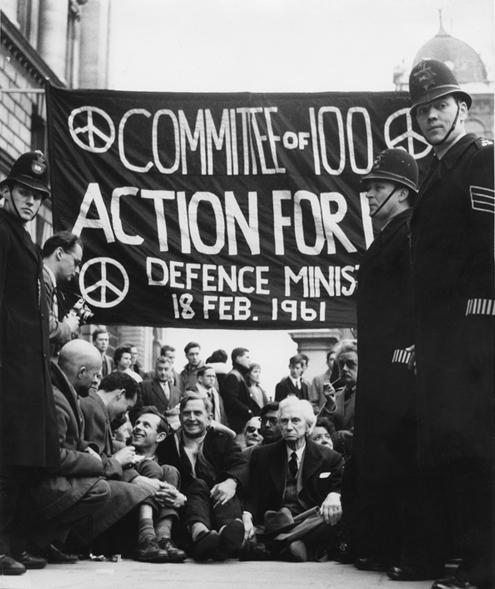
Bertrand Russell (right foreground) leads Committee march; courtesy peacebuttons.info
We are posting today (see below) three previously unpublished articles from the Committee of 100 archive, held by the IISG in Amsterdam, as part of our ongoing research into the early influence of nonviolence on the pacifist movements. During the summer of 1960, philosopher and activist Bertrand Russell was persuaded to resign his presidency of the Campaign for Nuclear Disarmament and assume the leadership of the Committee of 100, a newly planned movement for large scale nonviolent direct action against the manufacture and use of nuclear weapons. Together with Michael Scott, Ralph Schoenman, Michael Randle, April Carter and 95 other public signatories, 88-year-old Russell launched the Committee at a meeting in London on 22 October 1960. Its objective was to stop the “folly of nuclear armaments” through mass civil disobedience.
Right from the beginning the Committee of 100 strongly emphasized the nonviolent nature of the demonstrations, and anybody who wished to participate had to adhere to a long list of behavioral guidelines designed to safeguard the nonviolent integrity of the movement. Nevertheless, demonstrators expected to be arrested and charged and at the second of the sit-down demonstrations in April 1961 in London, over 800 people were arrested. That September, a week before the next mass demonstration, all one hundred committee members were summoned to court without charge for incitement to commit breaches of the peace. They were asked to sign a promise of good behavior for twelve months, but 32 refused, including Bertrand Russell, who opted to go to jail instead. The September demonstration was the largest organized by the Committee. Between 12,000 and 15,000 demonstrators flooded into the center of London, and more than 1,300 were arrested.
Read the rest of this article »
by Peter Cadogan
Aims: To ban the bomb. To prevent World War III. To rid the world of the power of militarists and military alliances. To understand the causes of war and to work out how to eliminate them. To identify the particular people, interests and factors making for World War III.
In face of the threat of war to alert people in Britain and throughout the world to the necessity of building a new kind of national and international movement against war. To achieve our purposes by direct action, without violence and by civil disobedience when need be. To give incidental support to conventional methods of opposition.
Read the rest of this article »
by the London Committee of 100
The London Committee of 100 is a body formed to organise mass nonviolent resistance, including civil disobedience, to nuclear and other weapons of mass destruction. This is a nonviolent demonstration. If you feel that you are not capable of remaining nonviolent in the circumstances of the demonstration, we would ask you not to take part. If at any time during the demonstration you feel that you are going to become violent, we would suggest that you leave the demonstration, at least for the time being.
Read the rest of this article »
by National Committee of 100
Despite the dangers of nuclear tests and the possibilities of nuclear war, we believe that there is hope. Despite the obstacles, we believe that:
- Men are capable of sanity and courage;
- Men can be moved to action to preserve life;
- Effective action is possible.
Read the rest of this article »
by Ken Butigan

Logo of Pax Christi International, courtesy www.paxchristi.net
Editor’s Preface: We are posting today three interrelated articles about the remarkable Vatican conference concerning nonviolence and just peace, including this essay by Ken Butigan, Pax Christi International’s statement, and Pope Francis’s greeting to the conference members. The theory of “just war” has been the prevailing Church doctrine since postulated by Saint Augustine in the 4th century (CE). There have been previous attempts to redefine or challenge it, most notably Vatican Council II’s statement condemning war (mentioned in Pope Francis’s article below) and Thomas Merton’s many essays on nonviolence and pacifism, especially those collected in Passion for Peace: The Social Essays, (New York: Crossroad, 1996). In the lead essay from that volume, “The Root of War is Fear”, written in 1961 for The Catholic Worker, Merton writes that the “duty of the Christian . . . is to do the one task which God has imposed upon us in the world today. That task is to work for the total abolition of war.” But nuclear weapons signify a new reality demanding new paradigms. This conference engages the struggle. JG
The atmosphere of an unprecedented gathering on nonviolence at the Vatican — where change-makers from every part of the globe deliberated with priests, bishops and the Catholic Church’s top officer for justice and peace — was electric from beginning to end.
Read the rest of this article »
by Pax Christi International
As Christians committed to a more just and peaceful world we are called to take a clear stand for creative and active nonviolence and against all forms of violence. With this conviction, and in recognition of the Jubilee Year of Mercy declared by Pope Francis, people from many countries gathered at the Nonviolence and Just Peace Conference sponsored by the Pontifical Council for Justice and Peace and Pax Christi International on April 11-13, 2016 in Rome.
Read the rest of this article »
by Pope Francis
Your Eminence [Cardinal Peter Turkson]
I am delighted to convey my most cordial greetings to you and to all the participants in the Conference on Nonviolence and Just Peace: Contributing to the Catholic Understanding of and Commitment to Nonviolence, which will take place in Rome from the 11th to 13th of April 2016.
This encounter, jointly organized by the Pontifical Council for Justice and Peace and Pax Christi International, takes on a very special character and value during the Jubilee Year of Mercy. In effect, mercy is “a source of joy, serenity and peace” (1), a peace which is essentially interior and flows from reconciliation with the Lord. (2) Nevertheless, the participants’ reflections must also take into account the current circumstances in the world at large and the historical moment in which the Conference is taking place, and of course these factors also heighten expectations for the Conference.
Read the rest of this article »
by John Dear
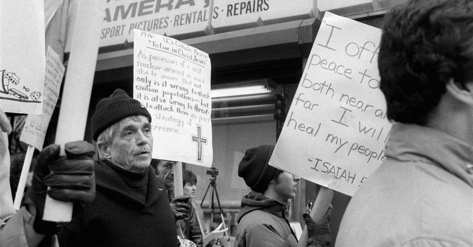
Daniel Berrigan marches for peace and against nuclear arms; New York City, 1982; photo courtesy AP
Rev. Daniel Berrigan, the renowned anti-war activist, award-winning poet, author and Jesuit priest, who inspired religious opposition to the Vietnam War and later the U.S. nuclear weapons industry, died on 30 April at age 94, just a week shy of his 95th birthday. He died of natural causes at the Jesuit infirmary at Murray-Weigel Hall in the Bronx. I had visited him just last week. He has long been in declining health.
Read the rest of this article »
by Geoffrey Ashe
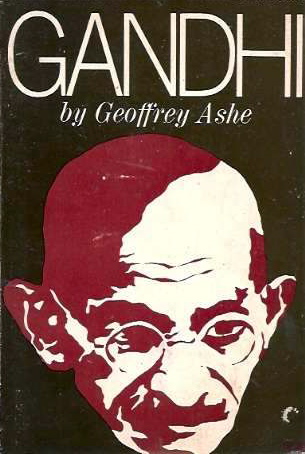
Dustwrapper art courtesy Stein & Day Publishing
Editor’s Preface: Gandhi was born in 1869 and as the centennial year of 1969 approached, pacifist and other publications worldwide used it as the occasion to re-evaluate Gandhi’s importance. The British cultural historian Geoffrey Ashe’s biography of Gandhi had been published to acclaim in early 1968 and Peace News published this article in their 16 August 1968 issue. It is the latest in our series of rediscoveries from the archives of the IISG in Amsterdam. Please see the notes at the end for references, acknowledgments, and further biographical information about Ashe. JG
Several months ago, Joan Baez described nonviolence as a flop, although she did qualify that by saying violence was a bigger flop. However, to my mind, we shouldn’t be downcast. By studying Gandhi’s nonviolence a little more carefully we can see what was right and wrong and make a fresh start. I am working on the Gandhi Centenary because I believe that some of the ideas which Gandhi explored in his career are still valuable and exciting, uniquely so; that these ideas can be restated and reapplied in the present context; but – what is perhaps the main thing – that no large-scale movement in this country has yet fully absorbed them or put them into practice.
Read the rest of this article »