Archive for November 2013

Cesar Chavez: Farmworkers Step Up Boycott

by Dorothy Day
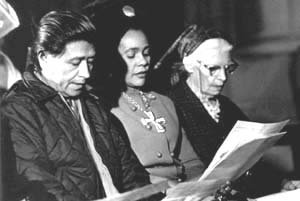
Chavez, Coretta King & Dorothy; February 1973; photographer unknown

EDITOR’S PREFACE: Dorothy Day was a prolific writer and so a note of explanation about our choice of articles seems in order. Not only did Dorothy write her monthly column “On Pilgrimage” for The Catholic Worker, but she was an inveterate diarist and letter writer, contributor of articles to other publications, novelist and author of autobiographical writings, speeches, et al. By posting these three essays on Cesar Chavez, and other articles that will follow, we hope to remind readers of the central role Dorothy and The Worker played in the contemporary nonviolent movement. Often tagged anarcho-pacifist, The Catholic Worker newspaper was also at the center of the Gandhian nonviolence movement, as we have previously demonstrated in postings about Danilo Dolci and nonviolence in Sicily. In this essay Dorothy mentions that she was asked to share a pulpit with Coretta Scott King and Cesar Chavez, two of the leading members of the US nonviolent movement.  This was neither deferential nor accidental. JG

It was a thrilling sight last month [February, 1973] to stand on the steps of the Cathedral of St. John the Divine and to see the parade of the United Farm Workers coming up the steps, all those beautiful, dark, sturdy men, women, and children, dressed in those clothes in which they work in the fields, flags flying with the Mexican Indian eagle black against the red of their banners, led by Cesar Chavez and Mrs. Martin Luther King. I had been invited too, but I could not take that long trek from the Riverside Drive Council of Churches headquarters, thru the Columbia University campus, and down to 110th Street where the Cathedral stands, magnificent in its stately grounds, on a height looking East over the City of New York.

I had enjoyed every minute of the evening before, and a fiesta held in the hall of the great old Paulist Church, surely one of the biggest in the city, where Marcos Munos (who heads the N.Y. office of the United Farm Workers) had prepared a party to greet the busload and caravan of ten cars which had made its zig-zag way across country from California. It was a pilgrimage to encourage the workers in various cities to continue the boycott of iceberg lettuce.
Read the rest of this article »

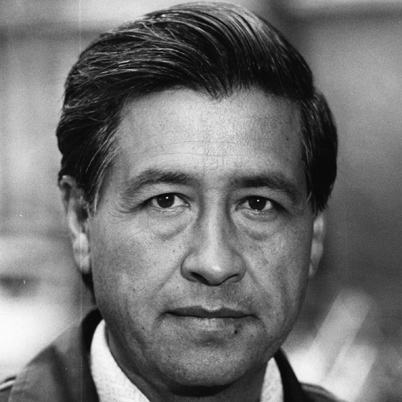
The Organizer Cesar Chavez

by Dorothy Day

Cesar Chavez, c. 1965; photographer unknown

“Workers of the World, unite. You have nothing to lose but your chains!” This is one of those stirring slogans of the Marxists especially appealing to youth, no matter what kind of family they come from, upper, middle, or lower middle class. If it does not attract them to Marxism, it at least gives them a sense of community and relatedness to other sufferers and combats the sense of futility and frustration, which encompasses so many.

Cesar Chavez is the leader of the Delano California farm-workers who are on strike in an area which stretches for 400 miles and includes thousands of acres of grapes, tomatoes, apricots, cotton — all kinds of crops. This strike, which has been going on since last September, appeals to all the poor of the United States. Chavez uses the word commitment, a word much in style now. But he combines it with the idea of necessity, the irrevocable. “We are committed,” he says. “When you lose your car, then lose your home, you do not become less committed, but more. None of us has anything more to lose.”

The agricultural workers of this country have long been the most abandoned and forgotten. They have been neglected in all Social Security legislation. From the first issue of The Catholic Worker, down through the years, we have written about the Negroes working on the levees, about the dispossessed sharecroppers of Arkansas and Oklahoma, the Mexicans in the onion fields of Ohio and Michigan, in sugar beets in the middle Northwest, about those who work in the potato farms in Maine, Long Island and New Jersey, in the turpentine woods of the South, about the citrus pickers of Florida, the Delta Negroes now being dispossessed from the cotton fields, and now the present strikers in California. The Catholic Worker has dealt with these stories and I have personally visited these fields of struggle.

Read the rest of this article »

Danilo Dolci’s Sicily

by Dorothy Day

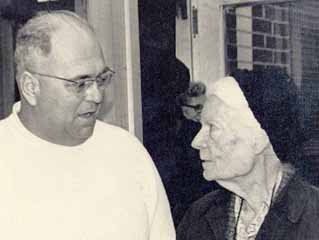
Dorothy & Dolci, 1968; photographer unknown; courtesy Swarthmore College Peace Center.

While I was in Rome I assisted at a dialogue Mass at the Jesuit headquarters on the Via Santo Spiritu in Rome just down the street from the Hospital of the Holy Spirit, where one can still see the turnstile into which destitute mothers used to place their newborn infants to be succored by the nuns. After the kiss of peace and communion we went out into the cobbled streets to find a place to have dinner – Eileen Egan, Dorothy Coddington, Gary McEoin, Tom Cornell, Fabrizio Fabbrini and I. The only trouble with such an interesting group was that there were too many things to talk about, too many avenues to be explored.

Fabbrini, a professor at the university in Rome, had lost his position and had been imprisoned for six months in a damp cold cell beneath the level of the street. He was in the same cell with nine others, not conscientious objectors but sentenced on various charges. There was neither work nor exercise nor recreation for him, and one wonders how he stood it.

Gary could have told me something about Vatican finances, since he has written a book on the subject, but Dorothy Coddington began talking about the work of Danilo Dolci, and her talk was so interesting that I resolved to visit Sicily before proceeding to London. Eileen was going on to Isreal and had already been to Trieste.

Read the rest of this article »

A Meeting with Ignazio Silone

by Dorothy Day

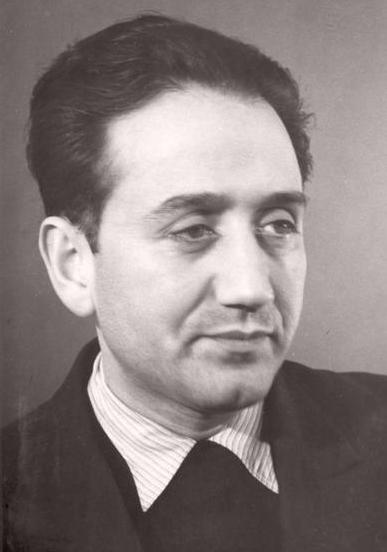
Ignazio Silone; photographer unknown.

In wrestling with the problem of how to present the teachings of nonviolence in an age of mass violence, it seems to me that the writings of Ignazio Silone are of immense importance. When I first read Bread and Wine in the forties, I was deeply impressed, not only with the story of the revolutionary returning secretly from his exile in Switzerland, but with the call to a personalist approach which must precede any communitarian effort.

I had heard from Father Jack English, a former CW editor, of Silone’s visit to the Trappist monastery of the Holy Spirit at Conyers, Georgia. Silone spent the day at the Abbey within the enclosure, and it was left to Father English to be guest master and converse with his wife, a beautiful Irish woman whom he met during his exile in Switzerland. They had come to Atlanta to discuss the problems of the South and had been brought to the monastery by the editor of the Atlanta Constitution because there was an international meeting of the Trappist order going on there.

On another occasion Silone and his wife had visited New York and New England and had called the office of The Catholic Worker, but I did not receive the message until they were well on their way back to Italy.

So I was delighted when I was invited to dine with them in Rome in late October. We went to a restaurant on the Piazza Carlo Goldoni that was usually very quiet, they said. There was a large area outside for dining; but it was a cool night, so we went into one of the small rooms, which, unfortunately, was very crowded and noisy that night. There were two tables full of noisy young Americans, one large party of uproarious Italians and still another family with small babies. So I did not get as complete an interview as I would have liked.

Read the rest of this article »

Guest Editorial: Campaign Nonviolence

by Pace e Bene

Campaign Nonviolence logo; courtesy of Pace e Bene

We are constantly being astonished these days at the amazing discoveries in the field of violence. But I maintain that far more undreamt of and seemingly impossible discoveries will be made in the field of nonviolence.”

M. K. Gandhi

The Campaign Nonviolence Pledge commits us to begin or renew our efforts to take up the way of active nonviolence practiced by Mahatma Gandhi and Martin Luther King, Jr. Everyone is invited to take the Campaign Nonviolence Pledge and join this new movement for peace with justice for humanity and creation. Organizations, groups, schools and religious communities are invited to endorse Campaign Nonviolence and to actively collaborate in building this movement.

Read the rest of this article »

Guest Editorial: A New Movement for Nonviolent Change

by Ken Butigan

Awash in the churning tsunami of violence that crashes through our world almost hourly — in the last week of September and the first week of October 2013 it included the unspeakable suicide bombings in Peshawar, the terror attack on the Westgate Mall in Nairobi, and the horror of a mass shooting on a basketball court in Chicago — it is difficult to believe that violence does not firmly and implacably hold the upper hand. But we are living in a time — and in part precisely because of the catastrophic violence we face— when people everywhere, either out of desperation or a miraculously incongruous sense of hope, are turning to the nonviolent option. In spite of everything, a swelling movement across the planet is moving methodically forward with a mysterious confidence in the possibility of a third way.

Read the rest of this article »

Guest Editorial: The Nonviolence Roadmap

by Metta Center for Nonviolence

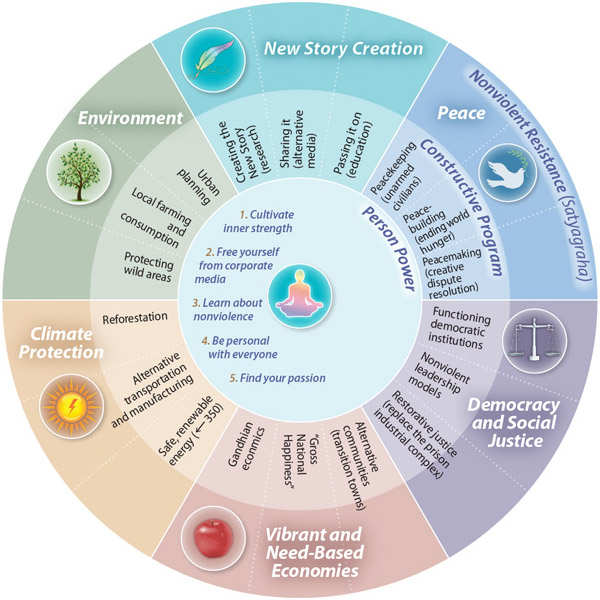
The Metta Center Roadmap

From Zuccotti Park to Tahrir Square, a groundswell of popular discontent has arisen to confront the menacing problems and deplorable injustice of the present world order. It is clear, however, that these manifestations were just the beginning. Roadmap is a way to get “from spontaneous protest to unstoppable movement”, to address the deepest underlying issues that cry out for change in a concerted way without sacrificing the creativity and verve of Occupy and similar movements around the world, and a way that can include many who have so far not been physically active.

Roadmap, the result of years of work and many conversations in Metta’s Friday “Hope Tanks,” board meetings, and other venues, incorporates key elements of the great successful nonviolent campaigns of Gandhi, Martin Luther King, Jr., and others. It is primarily designed for those who feel as we do that the “Great Turning” toward a world of peace and justice, of environmental sustainability and the possibility of fulfillment for every human being, deserves and requires commitment to the “long haul.”

Read the rest of this article »

Guest Editorial: Gandhi’s Prayer

by Stephanie Van Hook

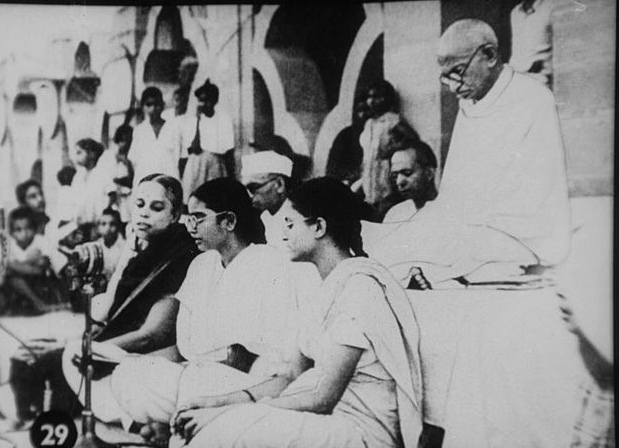
Gandhi in prayer c. January 1948, shortly before his assassination; photographer unknown; courtesy of commons.wikimedia.org

I am praying for the light that will dispel the darkness.
Let all those with a living faith in nonviolence join me in this prayer.
M.K. Gandhi

Gandhi was once given a seemingly impossible scenario: what would he do if a plane were flying over his ashram to bomb him? He rose to the challenge with an equally challenging answer: he would pray for the pilot. Some may take Gandhi’s response as preposterous. I argue, however, that his call to prayer was consistent with his vision of nonviolent strategy, for at least three reasons.

Reason 1: It meets the escalation of physical force with soul force.

Nonviolence requires strategic thinking; in other words, it requires a knowing of how to switch from one mode of operation to another in response to how the conflict is progressing. When a conflict escalates, a strategic response should also be prepared to escalate, not just with new tactics, but also through the depth of the nonviolence itself. Dr. King echoes this idea in his Dream speech, that the freedom struggle would meet “physical force with soul force.”

Read the rest of this article »


hrule
“When planted in the garden, the mustard seed, smallest of all the seeds, became a large tree, and birds came and made their home there.” Luke 13:19

“For me whatever is in the atoms and molecules is in the universe. I believe in the saying that what is in the microcosm of one’s self is reflected in the macrocosm.” M. Gandhi