by John Dear
I consider Martin Luther King, Jr. the great, holy prophet to the nation. He was a prophet of nonviolence sent by the God of peace and justice to call our country to repent of the sin of violence and war and to call us to the new life of nonviolence and peace. As we recall Dr. King, I hope we can remember his central, crucial, critical message.
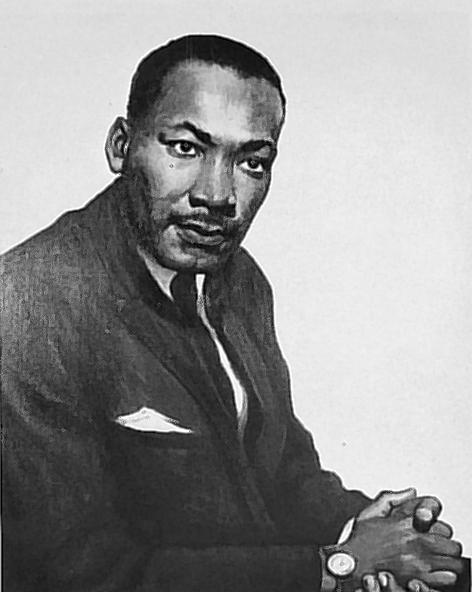
Dr. Martin Luther King, Jr.; painting by Betsy G. Reyneau; public domain image courtesy of commons.wikimedia.org
On April 3, 1968, the night before he was assassinated (by our government), Dr. King told thousands of people at the Mason Temple in Memphis, Tennessee: “For years now, we have been talking about war and peace. But now, no longer can we just talk about it. It is no longer a choice between violence and nonviolence; it’s nonviolence or nonexistence.”
It is no longer a choice between violence and nonviolence;
it’s nonviolence or nonexistence.
“Nonviolence or nonexistence.” That is the choice. These are the last words of Dr. King, the gauntlet he threw down before us, and before the whole world. Nobody talks about it, but this is the heart of Martin Luther King, Jr. It remains the critical choice before us all.
Read the rest of this article »
by John Dear
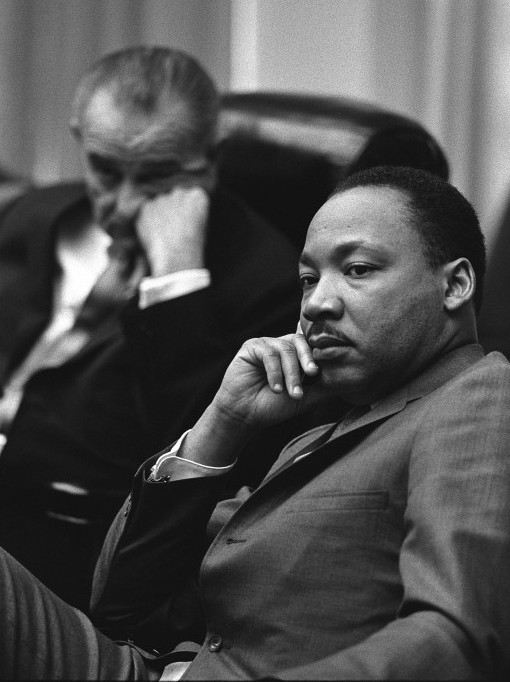
Dr. King with President Lyndon Johnson; photographer unknown; public domain image courtesy of commons.wikimedia.org
I’ve been reflecting on the principles of nonviolence, which Dr. Martin Luther King learned during the historic yearlong bus boycott in Montgomery, Alabama. After Rosa Parks refused to sit in the back of the bus, broke the segregation law, and was arrested on December 1, 1955, the African-American leadership in Montgomery famously chose young Rev. Dr. King to lead their campaign. He was an unknown quantity. Certainly no one expected him to emerge as a Moses-like tower of strength. No one imagined that he would invoke Gandhi’s method of nonviolent resistance in Christian language as the basis for the boycott. But from day one, he was a force to be reckoned with.
With the help of Bayard Rustin and Glenn Smiley of the Fellowship of Reconciliation, Dr. King articulated a methodology of nonviolence that still rings true. It’s an ethic of nonviolent resistance that’s also a strategy of hope, which can help us today in the thousands of Montgomery-like movements around the world, including environmentalism and the ongoing Arab Spring.
Dr. King outlined his way of nonviolence in his 1958 account of the Montgomery movement, Stride Toward Freedom (New York: Harper and Row, pp. 83-88). There he tells the story of the movement and his own personal journey, from which we can extrapolate his six nonviolence principles. Dr. King lived and taught these essential ingredients of active nonviolence until the day he died. (For an excellent commentary on them, I recommend Roots of Resistance: The Nonviolent Ethic of Martin Luther King, Jr., by William D. Watley, Valley Forge: Judson Press, 1985.)
Read the rest of this article »