by Corey Farr
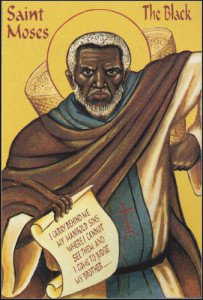
St. Moses the Black, a patron saint of nonviolence, 4th century CE; courtesy Orthodox Peace Fellowship; incommunion.org
The intent of this paper is to survey the attitudes of the early (pre-Constantinian) church towards violence, military service, and martyrdom and bring them into dialogue with contemporary US-American evangelical views and practices. I will examine this both in terms of the more passive and prohibitive critiques of culture and the more “active” affirmation of the merits of martyrdom. In doing so, I would hope to show that the church had not only the negative/passive witness of refusing to engage in violent acts, but also the positive/active witness of being willing to accept and even embrace violence done to themselves – in a way that is less pathological than it sounds – in imitation of their cruciform king.
As a long-time believer in nonviolence, I must admit that I was surprised to see the overwhelming evidence in favor of this position in the early church. Of course, I knew that there has always been a precedent for this belief throughout history, all the way back to the first century. That much, at least, I had learned from John Howard Yoder. (1) What surprised me was the wealth of quotes from patristics that spoke in no uncertain terms on the topic. My hope is that by doing this research and sharing it with those who are interested I might further reinforce and open opportunities to share my own Anabaptist inclinations with those in my generation who are burnt out, tired, and disillusioned with status quo evangelicalism ad nauseam. I remain an evangelical, despite my qualms with the stereotypes, because they are my people and I love them dearly – to misquote Luther, “Here I stand, and I can do no other.” But I do believe we have much to learn from the early church. For example, Jonathan Gorry notes that church fathers such as Tertullian, Origen, and Lactantius, who will each be featured in this paper, called for “pacifying forms of social engagement.” (2) Given the divisive and polarized political unrest among evangelicals today, such responses “can serve as useful antecedents for the regeneration of 21st century Christian critiques of state sovereignty.” (3) My prayer is that this paper shed a little light on those antecedents, thus lending credence to modern iterations of Christian nonviolence by demonstrating how in touch they are with the roots of the faith.
Read the rest of this article »
by Joseph Geraci
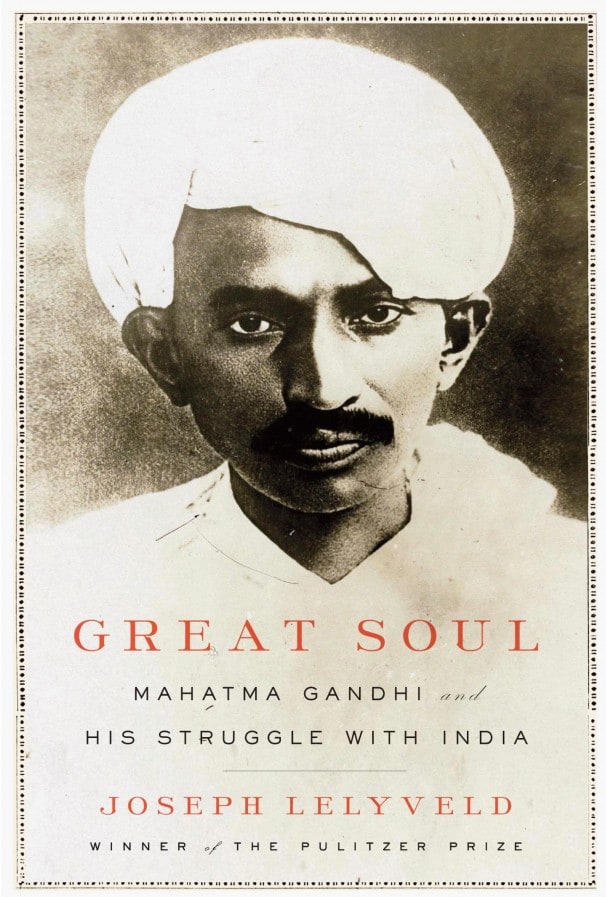
Dustwrapper illustration courtesy Knopf; aaknopf.com
There is an old Indian saying that could very well have been intended for Gandhi: “There’s no one more difficult to live with than a saint.” As portrayed in Joseph Lelyveld’s biography (1) Gandhi was indeed a difficult “saint”, husband, and father. He told his wife and children many times that community came first, and often lived apart from them, sometimes for years on end. His vow of celibacy (brahmacharya), he writes in his Autobiography, was taken in agreement with his wife, after he had already decided on it. When his second son Manilal wanted to marry, as Joseph Lelyveld reports, Gandhi was quite “crotchety” about it, inveighing that he could not “imagine a thing as ugly as the intercourse of man and woman,” not precisely the sort of remark one would hope a father would make to a son anticipating a wedding night. The eldest son, Harilal was unstable, alcoholic, and was accused of embezzling. In the 1930s he converted to Islam, only six months later to reconvert to Hinduism, as if torn between defying or pleasing his father. Gandhi surely must bear some responsibility for his son’s dysfunction.
Gandhi’s attitude towards nonviolence also has its contradictions. If from the beginning of his career as a lawyer in South Africa he was committed to nonviolent resistance, that is, satyagraha, persistence in the truth, he also in South Africa held the rank of lieutenant colonel in the British militia, if as a noncombatant. He famously wrote, “Where there is a choice only between cowardice and violence I would advise violence.” And later he was also to say, “I would risk violence a thousand times rather than the emasculation of a whole race.” Lelyveld questions whether Gandhi’s numerous satyagraha campaigns had any lasting effect. His attempts to change the plight of the untouchables, his efforts to prevent the division of India and violence between Muslims and Hindus, were largely unsuccessful. Many scholars have argued that satyagraha was only one of many factors that led to Indian independence. Was the idea of nonviolence a greater achievement than any result?
Read the rest of this article »
by Andrew Rigby
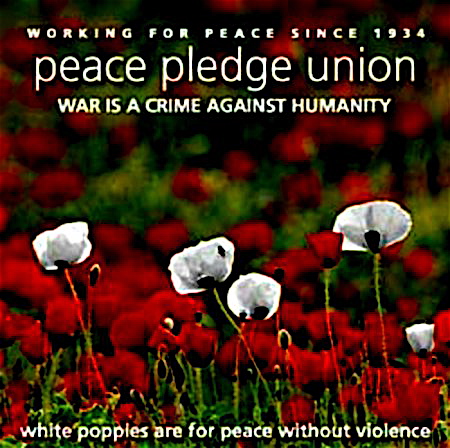
Peace Pledge Union poster courtesy hastingsonlinetimes.co.uk
“If we got, say, a million voters actively insisting that they’ll never take part in any war,
the Government would have to begin to take notice.” Dick Sheppard. (1)
Such was the optimistic hope and political strategy of Dick Sheppard, the founder and moving spirit of the Peace Pledge Union (PPU), writing in 1936. His faith in the possibility of creating a pacifist movement of such a scale that no government could afford to ignore its influence was not totally unfounded at that time. The PPU had a membership of over 118,000, with some 300 local groups in existence, and a weekly newspaper (Peace News) with sales of approximately 6,000. The origins of the PPU date back to October 1934, when Sheppard published his Peace Letter requesting people to contact him who shared his pacifist determination to renounce war and never support or sanction another one. The burgeoning growth of the PPU in those pre-war days, as the New Statesman observed, lay in its appeal “not only to the convinced absolutist pacifist but to the large number of people with only slight political knowledge but with a recent realization of the fearful imminence of war, who are fascinated by the direct simplicity of the crusade.” (2)
Read the rest of this article »
by Nathan Schneider

Peacebuilding illustration courtesy myzimdialogue.com
Preface: Mark Johnson was Executive Director of the Fellowship of Reconciliation (2007-2013), an organization that stood in opposition to two world wars and helped foster the civil rights movement’s ethic of nonviolence, in addition to being an early advocate for interfaith dialogue. Under his leadership, the FOR learned to find a place for itself amidst the proliferation of institutions—both religious and secular, governmental and civil—that claim the mantle of making peace. The interview was conducted in December 2009. Please see the notes at the end for further information and acknowledgments. NS
Nathan Schneider: Since its founding, how has the Fellowship of Reconciliation (FOR) been involved in promoting peace around the world?
Mark Johnson: The Fellowship of Reconciliation began in 1914, when an English Quaker and German Lutheran agreed that they wouldn’t let the emerging war separate the fellowship they had established. A year later, one of their mutual friends, John R. Mott, invited them to form an organization at a conference in Long Island, and there, in 1915, the FOR was established. The early work, which helped frame FOR’s efforts through the Vietnam War era, had to do with the right to conscientious objection.
Read the rest of this article »