Why Lawyers Fear Love: Mohandas Gandhi’s Significance to the Mindfulness in Law Movement
by Nehal A. Patel
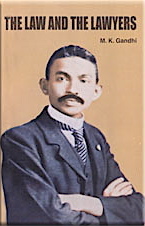
Book jacket art courtesy mkgandhi.org
“As regards lawyers, the position is worse still. Have they overcome their infatuation for law-courts? … Have the lawyers realized that justice should not be costly? … Lawyers have not yet overcome the allurement of fat fees and, in consequence, the cost of justice continues to be counted in terms of gold and guineas … justice cannot be sold.” M.K. Gandhi (1)
ABSTRACT: Although mindfulness has gained the attention of the legal community, there are only a handful of scholarly law articles on mindfulness. The literature effectively documents the Mindfulness in Law movement, but there has been minimal effort to situate the movement within the broader history of non-Western ideas in the legal academy and profession. Similarly, there has been little recent scholarship offering a critique of the American legal system through the insights of mindfulness. In this article, I attempt to fill these gaps by situating the Mindfulness in Law movement within the history of modern education’s western-dominated worldview. With this approach, I hope to unearth some of the deep challenges facing a mindful revolution in law that are yet to be widely discussed.
In Part I, I introduce the current mindfulness movement in American society. In Part II, I summarize the current Mindfulness in Law movement and the treatment of “Eastern” thought in modern education. I also describe the three levels of change discussed in academic literature: individual, interpersonal, and structural change. In Part III, I discuss how Mohandas Gandhi exemplifies all three levels of change. In Part IV, I offer critical appreciation of the Mindfulness in Law movement by highlighting Gandhi’s insights on structural reform. I conclude that a mindful application of Gandhi’s thought suggests that satyagraha be incorporated into a constitutional framework, thus making legally protected speech out of forms of public-state dialogue that are traditionally “extra-legal” and used disproportionately by marginalized populations.