Archive for January 2018

Guest Editorial: Martin Luther King, Jr. and “The Year of Nonviolence or Nonexistence”

by John Dear
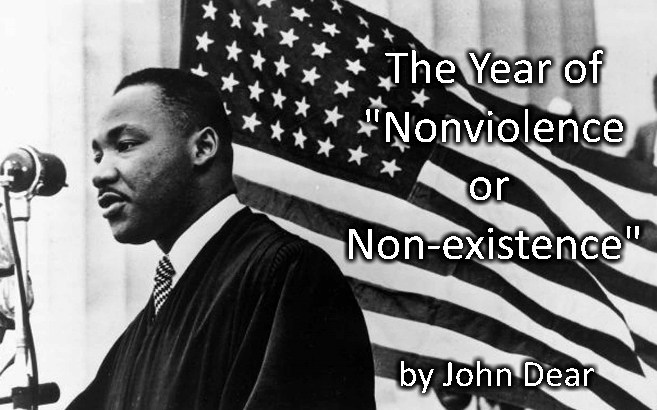
Poster art courtesy paceebene.org

It was early 1968. Since the previous spring Martin Luther King, Jr. had been pursuing a course that for many was unthinkable. He had deliberately connected the dots between the movement for civil rights and the struggle to end the war in Vietnam, and had paid the price. He was roundly criticized by the Johnson administration and the media, as well as by people in his own movement. From the right he was attacked for having the gall to question US foreign policy. From the left he was lambasted for losing focus and not keeping his eyes on the prize.

He even got it from a childhood friend who stopped by the house one afternoon to vent. “Why are you speaking out against the Vietnam War?” he carped. King put aside his customary oratory. “When I speak about nonviolence,” he patiently explained, “I mean nonviolent all the way.”
Read the rest of this article »

Ahimsa: The Way of Nonviolence

by Mohandas K. Gandhi

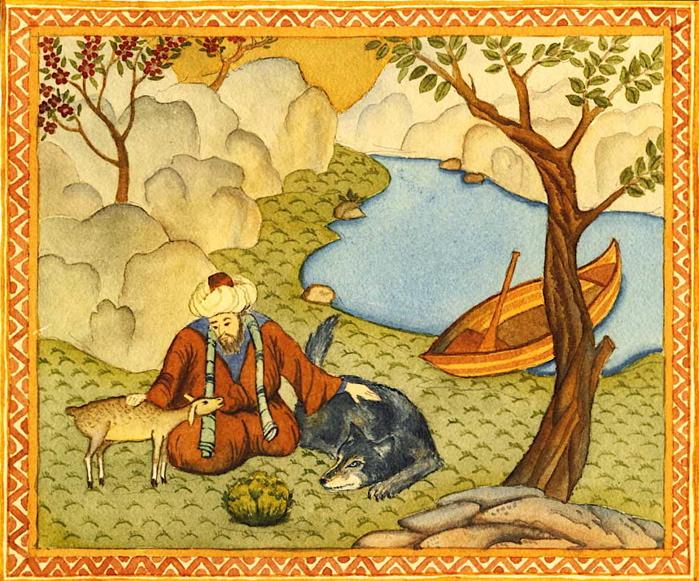
Sufi Saint Pacifying the Animals; c. 18th century Persian miniature courtesy dharmadeen.com

Editor’s Preface: We have previously posted a compilation of Gandhi’s writings on satyagraha. Through these, and by using quotes from his work at the top of our Home page, collected under Quotes & Sources, we hope to provide focal points for discussion, if not statements of doctrine. Please also see the notes at the end for a comment on the texts, and acknowledgments. JG

Non-violence is the greatest force at the disposal of mankind. It is mightier than the mightiest weapon of destruction devised by the ingenuity of man. Destruction is not the law of the humans. Man lives freely by his readiness to die, if need be, at the hands of his brother, never by killing him. Every murder or other injury, no matter for what cause, committed or inflicted on another is a crime against humanity. (MM, 49)

The first condition of non-violence is justice all round in every department of life. Perhaps, it is too much to expect of human nature. I do not, however, think so. No one should dogmatize about the capacity of human nature for degradation or exaltation. (MT, V, 344)

Read the rest of this article »

For the Love of All: Ahimsa in Nonviolence and Radical Ecology

by Saskia van Goelst Meijer

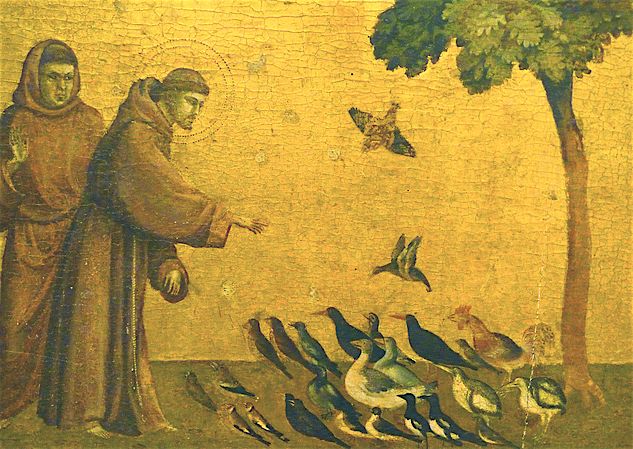
St. Francis Preaching to the Birds; fresco by Giotto, courtesy wikiart.org

There is a difference here between proactive non-harming
and “doing nothing.”
 — Irina Aristarkhova (2012)

Our world is experiencing an ever-growing ecological crisis, which makes it necessary for humanity to reshape the way it is dealing with the planet. Grave challenges for the future of humanity and the earth as a whole have emerged as a result of ecological and economic conduct over the past few centuries. According to some, the environmental crisis is intertwined with other crises (financial, social, political), which has led both scholars and activists to call for a fundamental change in the global paradigm. Where socio-political change is concerned, part of this paradigm change has been attempted through nonviolence. Pioneered as a method in the early 20th century by Mohandas Gandhi for addressing injustice, it has since been taken up by many more individuals and organisations around the world. Nonviolence practices and notions can also be found in certain streams of ecology. One central element in the method of nonviolence is ahimsa, ‘the absence of the intention to do harm.’ In this article I will explore both ahimsa and radical ecology, to both explain the role and significance of ahimsa in nonviolence and to see if and how the two notions can clarify and supplement each other.

Read the rest of this article »

By Giving Our Lives, We Find Life: The John Dear Interview with Cesar Chavez

by John Dear

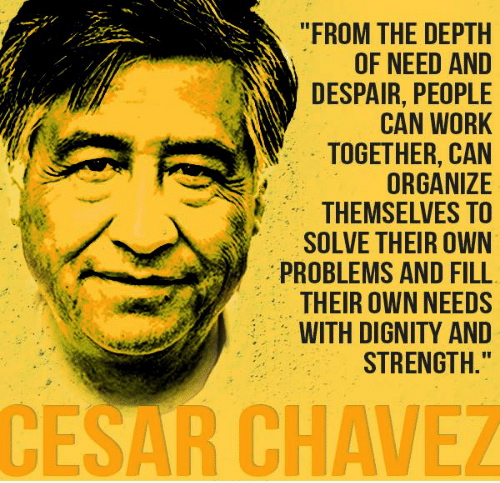
Cesar Chavez poster art courtesy me.me/t/cesar-chavez?s=new

Editor’s Preface: John Dear conducted this interview in August of 1992, upon the occasion of the annual Pax Christi conference in New York, and just a few months before Chavez’s untimely death. Please see the note at the end for further information about Chavez, links, and acknowledgments. JG

Cesar Chavez lived his life in service of others. A servant of the poor, a servant of justice, a servant of nonviolence, he founded and led the United Farm Workers Union in their struggle for justice. A steadfast practitioner of nonviolence, he fasted, prayed, marched, picketed and boycotted his way to justice.

In April 1993, he traveled to Arizona to stand trial in a lawsuit against a grape-growing company. He also fasted privately for six days. At the end of the fast, on the evening of April 22, 1993, he retired to his room. He died quietly with a book in his hands. He was 66 years old.

Like tens of thousands of others, I journeyed to Delano for his wake and funeral at Forty Acres, the former UFW headquarters in the heart of California’s Central Valley. Fifteen thousand farmworkers viewed his body in an open pine wood coffin, made by his brother. They gathered for the evening vigil and rosary service under a huge tent with a large banner picturing Cesar. The prayers, scripture readings, testimonies and songs continued on through the night until the start of the march the next morning.

Read the rest of this article »

Gandhi and the Virtue of Forgiveness

by Alan Hunter and Andrew Rigby

“Forgiveness” art by Leigh Wells; courtesy greatergood.berkeley.edu

Abstract: Satyagraha and ahimsa are widely acknowledged as central to Gandhi’s life-work.  Our argument in this paper is that forgiveness (ksama in Sanskrit) was another of Gandhi’s core values. The first section of the paper introduces ways in which forgiveness has been understood as a concept and practice within Western traditions. We demonstrate that forgiveness lies close to the heart of Christianity, and show that it is also an issue relevant to contemporary concerns: since the 1990s forgiveness has featured in numerous secular studies, exhibitions, websites, and other media. The second section identifies how the key precepts that informed Gandhi’s vision of the transformatory significance of forgiveness were derived from and grounded in the spiritual and philosophical traditions of South Asia, Hinduism and especially Jainism. Our final section more specifically explores the implications of forgiveness in Gandhi’s thought and practice. Forgiveness is an important component of Gandhi’s dual concerns: the ‘spiritualisation of politics’, and also the ‘politicisation of spirituality’.

Read the rest of this article »


hrule
“When planted in the garden, the mustard seed, smallest of all the seeds, became a large tree, and birds came and made their home there.” Luke 13:19

“For me whatever is in the atoms and molecules is in the universe. I believe in the saying that what is in the microcosm of one’s self is reflected in the macrocosm.” M. Gandhi