Gandhi’s Constructive Programme: The Other Side of Civil Resistance
by Andrew Rigby
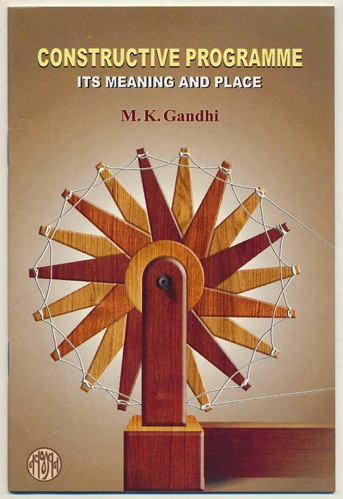
Dustjacket art courtesy mkgandhi.org
Gandhi was a special figure in the history of movements for social transformation, and as such has been the subject of countless studies — most recently by activist-scholars and students of civil resistance seeking to identify the key lessons that can be applied to more contemporary nonviolent movements for peace and justice. As such they have tended to focus on the large-scale satyagraha campaigns initiated by Gandhi in the Indian freedom struggle, such as the Salt March of 1930 that inaugurated a mass civil disobedience campaign and the 1942 ‘Quit India’ campaign. Less attention has been paid to exploring the significance and contemporary relevance of the other major dimension of Gandhi’s approach to transformation – constructive action to lay the foundations of new ways of living (what has been called by more recent generations of activists as pre-figurative politics).
Gandhi believed there should be two integral dimensions of any campaign to transform systems of oppression and injustice. There was the front-stage satyagraha, or active nonviolent resistance, but there was also the constructive work to create alternatives to the systems and practices that were in need of change. Indeed, for Gandhi the constructive work was far more important than the active ‘political satyagraha’ in the struggle for emancipation and independence (Swaraj). As he advised his co-workers in 1944, through the constructive programme ‘you can make the villages feel self-reliant, self-sufficient and free so that they can stand up for their own rights. If you make a real success of the constructive programme, you will win Swaraj for India without civil disobedience.’ (1)