by Richard Ricketts
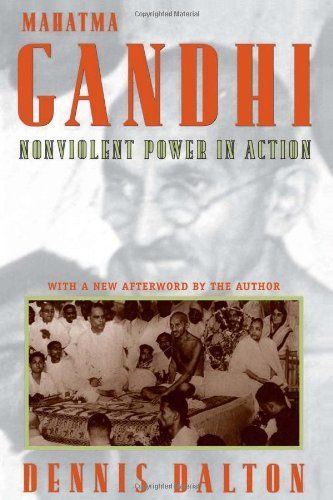
Dustwrapper art courtesy cup.columbia.edu.
Editor’s Preface: Dennis Dalton is Ann Whitney Olin Professor Emeritus of Political Science at Barnard College, Columbia University, and a leading authority on Gandhi and civil resistance. Please see the note at the end for bibliographical information, and acknowledgments. JG
Richard Ricketts: Do you see resistance to Peace Studies as a field of study?
Dennis Dalton: That is a hard question. Many universities have institutes and centers that incorporate the word “peace,” such as the Institute of War and Peace at Columbia, but all they typically study is the war side of the equation. Peace is seen as a passive phenomenon, as an absence of war, so it is thought that there is nothing there to study.
I suspect this line of thinking is encouraged, in part, by the large grants that are provided from the Department of Defense. Columbia, for example, has traditionally been funded very liberally by the Defense Department and the money is just not there for peace studies. That is why I was really interested in this program at Arizona State University. The founder of the program Ann Hardt was really committed to peace and peace studies. You need someone like that who can fund these types of programs.
When I went to the instruction/education board meetings [at Columbia], I was told the subject was academically soft, not rigorous enough. What they meant was that they deemed pacifism as a weak, effeminate subject.
Read the rest of this article »
by Brett Keegan
Jacket art courtesy Rowman & Littlefield; rowman.com
Editor’s Preface: Barry Gan is professor of philosophy and director of The Center of Nonviolence, St. Bonaventure University, Saint Bonaventure, New York. The interview was conducted by his student, Brett Keegan, for the open source, academic website figureground.org and posted there October 28, 2013. For further information about Gan and acknowledgments please see the note at the end. JG
Brett Keegan: So, how did you get introduced to peace studies and nonviolent philosophy?
Barry Gan: The long story goes back to when I was a child. I was the only Jewish kid in a neighborhood of all Christians, and had been apprised by my parents that we were sort of different from everybody else in the neighborhood when we moved there when I was about six. And somehow, I always found myself in the role of peacekeeper among friends who were often getting involved with fights. I don’t know if it was out of fear, or just a sense of the stupidity of fights, but I never got involved. I would always try to talk people out of them, talk people through them.
Later, when I was at summer camp and my older brother was at summer camp with me, I remember there was this other kid there who was always getting picked on by everyone. And since I wasn’t from their school, I didn’t know why they were picking on him. I just found it annoying. And I remember challenging the bully at the time and wrestling him to the ground to get him to stop picking on this one kid.
Read the rest of this article »
by William J. Jackson
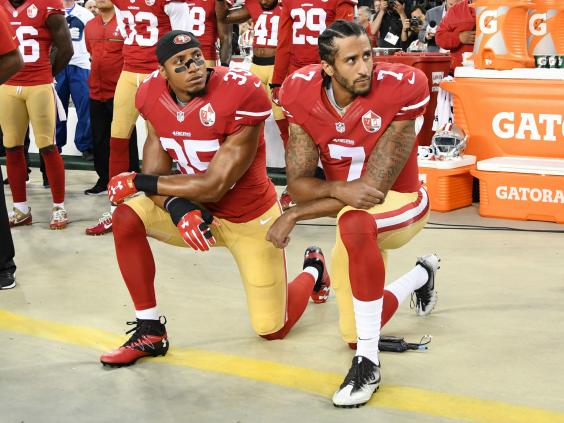
Colin Kaepernick and Eric Reid of the San Francisco 49ers kneel in protest during the national anthem prior to playing Los Angeles Rams in NFL game; courtesy Getty Images
(1) New forms of nonviolent protest, and renewed uses of old forms, are in the headlines; the kneel-in, for example, a protest that has recently spread among athletes. Many people are not aware of the history and the philosophy involved. Not knowing the background, some critics misunderstand and grow angry. Even the liberal and usually knowledgeable Supreme Court Justice Ruth Bader Ginsberg called the kneel-in “dumb” and “disrespectful.” (Soon thereafter she took it back: “Barely aware of the incident or its purpose, my comments were inappropriately dismissive and harsh.”) Many people seem unable to put kneel-ins in a historical perspective. So I feel it might help deepen our understanding to look into the background, the meanings, and intentions of some of these practices. Maybe being better informed could help critics comprehend what is happening. (1)
Read the rest of this article »
by Omair Ahmad
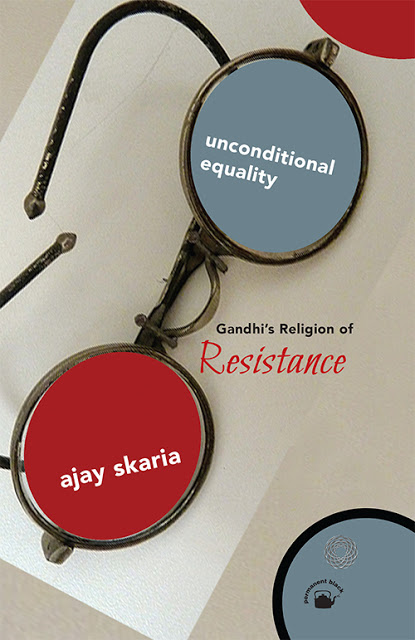
Dustwrapper of India edition courtesy permanent-black.blogspot.nl
Omair Ahmad: It is rare to speak of ‘religion’ in the political domain these days and you mention your own difficulties in breaking out of the secular mould to read Gandhi in this light. Could you explain?
Ajay Skaria: I must confess that like most others who had come of intellectual age as part of the Indian left, I was for long suspicious of Gandhi because of his overt religiosity. Certainly, if you had asked me as late as 2000, whether there was any chance that I would work on Gandhi, I would have emphatically said ‘no.’ And I would have said so partially because both as a college student and later in my work in the adivasi tribal regions, I often encountered too many Gandhians running ashrams that effectively practiced an upper caste Hinduism. Even now, to my mind, his Hinduism as a social phenomenon arguably enabled the later rise of militant Hinduism, Hindutva.
I was drawn into Gandhi’s writings completely by accident. In 2000, I was teaching the English Hind Swaraj in an undergraduate class and a passage from it intrigued me. Since I happened to have the Gujarati text close at hand I consulted it. I had in fact just bought it during my trip earlier that year to Ahmedabad since the person I was then working with, Indulal Yagnik, was first a Gujurati associate and then a critic of Gandhi. There was considerable divergence between the Gujarati and English. As I read more, I realised that the divergences were quite numerous, and it became increasingly clear to me that Gandhi’s writing might be doing something quite different from what he may have intended it to do.
Read the rest of this article »