Archive for August 2016

Seeds of Revolution: The ACRES U.S.A. Interview with Vandana Shiva

by Chris Walters
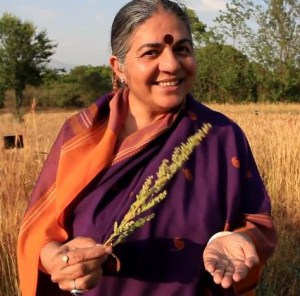
Photograph of Vandana Shiva courtesy ecofarmingdaily.com

Acres U.S.A.: How should we approach the story of Indian agriculture?

Vandana Shiva: The first thing you need to remember is that India is a land which has been farmed for 10,000 years continuously and sustains more than a billion people on its agriculture. India is the land where the British were the rulers, and in 1891 they sent John Augustus Voelcker to make a survey. He wrote a report on Indian agriculture that was published two years later. He said he could find more ways that Indian farmers could advise Great Britain about how to improve its farming than ways the British could advise India. He wrote that Indian agriculture was not backward, and that in many areas there was little or no room for improvement. Then the imperial British government sent Albert Howard to India in 1905. He arrived to find the fields were fertile. He found no pests damaging the crops, and he decided to make the study of peasant agriculture his profession. The agricultural testament that resulted from his studies became the basis of the organic movement worldwide — the Soil Association in the U.K., Rodale in the United States, all of them came out of Howard’s information, and Howard’s inspiration was ancient Indian agriculture. He so clearly distinguished between, as he said, the agriculture of the Occidental world and the agriculture of the Orient.
Read the rest of this article »

Protecting the Earth with Vandana Shiva

by John Dear 

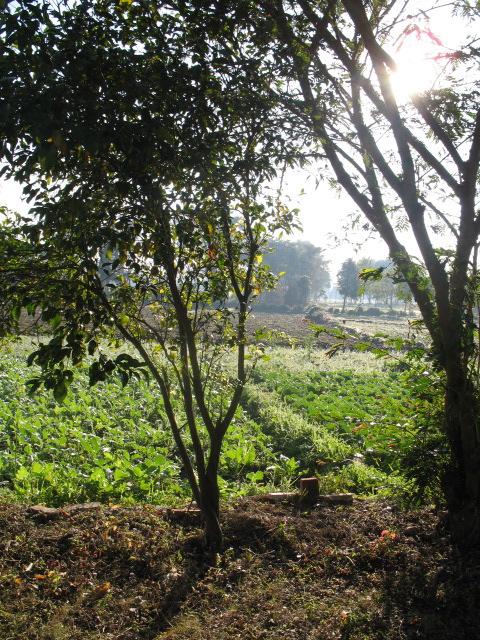
Photo of Vandana Shiva’s Navdanya organic farm courtesy avery.wellesley.edu

As I follow the regular, dire reports on global warming, I recall my visit two years ago (2007) into the foothills of the Himalayas near the border of China and Nepal, north of Dehradun in India. There I met Dr. Vandana Shiva, a leading anti-globalization and environmental activist, a brilliant, engaging scientist and Gandhian activist.

She has taken up a formidable challenge, a nonviolent civil resistance campaign to resist globalization and protect farmers, not to mention the earth itself. Her strategy is to harvest every endangered seed and indigenous plant, restore the soil to its original richness, and save the seeds from corporate patent theft by creating “seed banks.” She is a modern-day Noah, gathering for the future the plants of the world.

I toured Navdanya Farm, her farming commune and laboratory for biodiversity conservation and farmers’ rights, then moved on to see Bija Vidyapeeth (Earth University), a college she founded to teach sustainable living and global alternatives. There one learns new ways to cook, garden, compost, farm, organize politically, and practice yoga.

The fields of Navdanya Farm teem with every imaginable crop and spice. Over 600 species of plants grow there, along with 250 types of rice. White egrets pace gracefully among the fields. Here agricultural scientists have also embraced Gandhian nonviolent resistance methods to protect the earth.

Read the rest of this article »

The Story of Salt

by Mohinder Singh

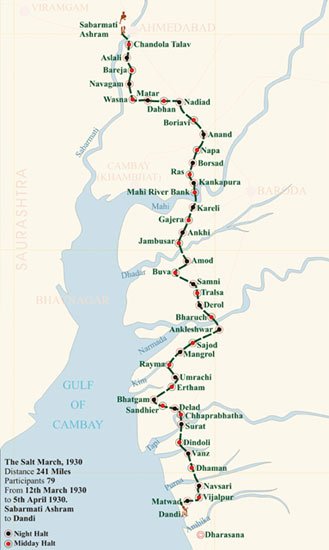
Map of Gandhi’s salt march courtesy indiansaltmarch.weebly.com

Editor’s Preface: Gandhi’s Salt March was one of his most significant nonviolent civil resistance campaigns, yet without knowing some of the historical significance of salt his symbolic gesture of gathering a handful cannot be understood. For further reflections on Gandhi and salt see also the article ”Salty Gandhi” by William J. Jackson posted here. The note at the end has further information and acknowledgments. JG

The German scholar M.J. Schleiden in his book Das Salz (Leipzig, 1875) contended that there was a direct correlation between salt taxes and despots. Athens did not tax salt, but China and Mexico were salt-taxing tyrannies. Using the salt-taxation yardstick, British rule in India was patently despotic.

Salt taxation originated in China. The earliest known written text on salt regulation is the Chinese Guanzi: On Weighing and Balancing Economic Factors (c. 300 B.C.). It argued that people cannot do without salt, and in their desperation would be willing to pay a high price; it states ‘Coastal states dependent upon the resources of the ocean should cautiously and reasonably establish a tax on salt.’ In due course, this proposal became the adopted policy of the Chinese emperors and the first known instance of a state-controlled monopoly of a vital commodity. The revenues from salt taxation were used to build not only armies but also defensive structures such as the Great Wall. At one time over half of the state’s revenue was derived from salt. Any popular manifestation of resentment against it was handled with an iron fist.

Read the rest of this article »

Aspects of Nonviolence in American Culture

by Mulford Q. Sibley

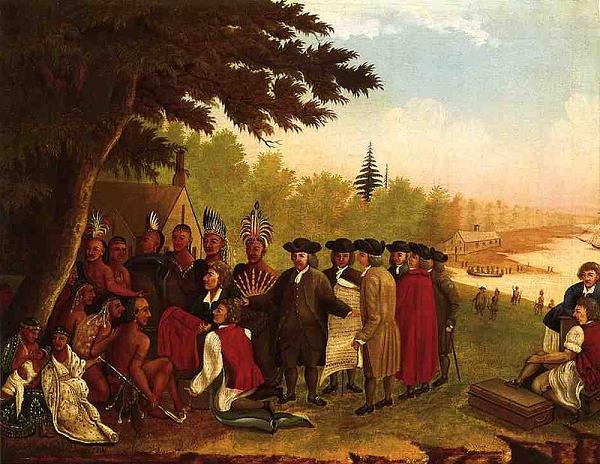
Edward Hicks, “William Penn’s Peace Treaty with the Indians”; courtesy en.wikipedia.org

Editor’s Preface: Mulford Sibley wrote this article in the early 1960s as his contribution to the scarce anthology Gandhi: His Relevance for our Times, edited by G. Ramachandran and T. K. Mahadevan, New Delhi: Gandhi Peace Foundation, 1962. Please see the Editor’s Note at the end for further information about Sibley, and acknowledgments. JG

American culture, it is sometimes said, has been peculiarly violent, both in outlook and in practice. It has exalted physical force, praised rough action, and placed in the forefront such cynical statements as “Fear God and keep your powder dry.” One of America’s leading Presidents Theodore Roosevelt is well known for his advice to “speak softly but carry a big stick.” (1) Violence has been associated with the frontier spirit, the Westward movement treatment of the American Indian, the rise of business corporations, and the development of labor organizations. Violent crimes are more numerous proportionately than in most other nations of the world; and the police, by contrast with those in Britain, are heavily armed. Popular culture, moreover, if we are to take radio, television, cinema, and pulp magazines as indicators, exults in violence.

Read the rest of this article »


hrule
“When planted in the garden, the mustard seed, smallest of all the seeds, became a large tree, and birds came and made their home there.” Luke 13:19

“For me whatever is in the atoms and molecules is in the universe. I believe in the saying that what is in the microcosm of one’s self is reflected in the macrocosm.” M. Gandhi