by William J. Jackson

Taoist compassion artwork; courtesy justgeneo.wordpress.com
The gently persuasive way—not beating others into submission, not bludgeoning, not eye-for-eye and tooth-for-tooth vengeance, but turning the other cheek, going the extra mile, giving more than is asked, killing the others’ “foeness” with kindness—is an ancient approach. It includes longsuffering, even self-sacrifice, loving your enemy, praying for those who persecute you. This is a Christian teaching, and is also ancient Taoist wisdom philosophy.
The Taoist classic text Tao Te Ching includes a number of lines about humility and not lording it over others, observations of patterns already recognized as very old wisdom 2500 years ago. TTC Chapter 68 is about the virtue of not contending; it speaks of “intelligent non-aggressiveness” and the “virtue of non-contention.” In Taoist philosophy one who accepts the “left tally, the debtor’s tally” (a symbol of inferiority in an agreement, getting the short end of the stick), humbly accepts the less prestigious position, which in the long run is the appearance the victor should have. To flaunt one’s victory sets a tone that brings resentment and reprisals. “Those who dispute are not skilled in Tao.” (TTC Chapter 81) Water flows downhill, and does not fight gravity. (1)
Read the rest of this article »
by Devi Prasad
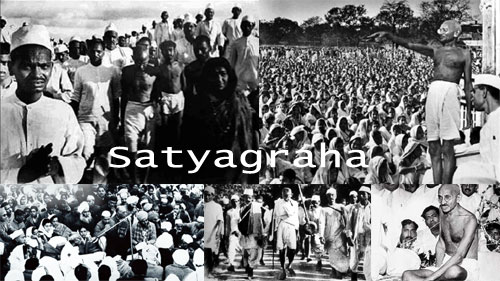
Gandhian civil resistance poster; courtesy peacetopia.com
To begin with I shall discuss some of the commonly used terms in connection with nonviolent action against oppression, and which are often mistakenly understood to be the same as the Satyagraha practiced and advocated by Gandhi. This is to try to point out the differences between the concepts these terms represent and how they are not quite the same as the concept of Satyagraha. These terms are passive resistance, non-cooperation, direct action, civil disobedience and non-resistance. My aim is not to minimise, even to the slightest degree, the merits, uses and strength of these methods, but to point out that in contrast to any of them Satyagraha is a complete philosophy, as well as the technique of fundamental social change. Whereas the philosophy of Satyagraha implies a holistic approach to both long term as well as immediate issues facing humankind, the practice of the above-mentioned concepts is, by definition, limited to particular situations without being necessarily related to other social or political problems.
Read the rest of this article »
by Chaiwat Satha-Anand

Book jacket art courtesy usip.org
From 1982 to 1984, Muslims from two villages in Ta Chana district, Surat Thani, in southern Thailand had been killing one another in vengeance; seven people had died. Then on January 7, 1985, which happened to be a Maulid day (to celebrate Prophet Muhammad’s birthday), all parties came together and settled the bloody feud. Haji Fan, the father of the latest victim, stood up with the Holy Qur’an above his head and vowed to end the killings. With tears in his eyes and for the sake of peace in both communities, he publicly forgave the murderer who had assassinated his son. Once again, stories and sayings of the Prophet had been used to induce concerned parties to resolve violent conflict peacefully. (1) Examples such as this abound in Islam. Their existence opens up possibilities of confidently discussing the notion of nonviolence in Islam. They promise an exciting adventure into the unusual process of exploring the relationship between Islam and nonviolence.
This chapter is an attempt to suggest that Islam already possesses the whole catalogue of qualities necessary for the conduct of successful nonviolent actions. An incident that occurred in Pattani, Southern Thailand, in 1975 is used as an illustration. Finally, several theses are suggested as guidelines for both the theory and practice of Islam and the different varieties of nonviolence, including nonviolent struggle.
Read the rest of this article »
by Acharya K.K. Chandy
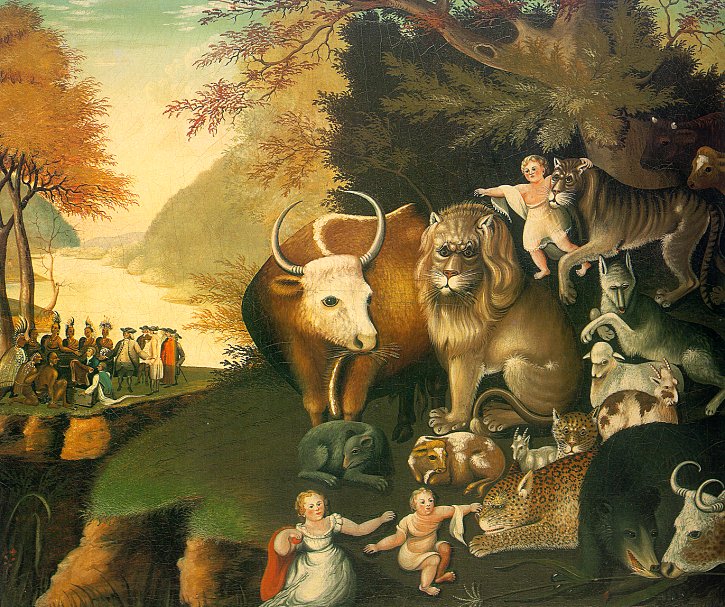
Edward Hicks, “The Peaceable Kingdom”; courtesy National Gallery of Art, Washington, D. C.; nga.gov
Editor’s Preface: In the writings about Gandhi’s constructive programme, there are rarely any attempts made to compare it with historical precedents. Acharya Chandy has had the insight that William Penn’s Peaceable Kingdom of Pennsylvania is an apt precursor of a Gandhian community. This previously unpublished article continues our research project at the International Institute for Social History (IISG) in Amsterdam. Please consult that category for other articles, and the project’s statement of purpose. Please also see the notes at the end for acknowledgments, biographical details, and especially a note on the condition of the text. JG
In a context where the survival of the species through nuclear war or environmental degradation has become a main anxiety of the day, ignoring the warnings given by Christ and Gandhi would be to our peril as individuals and nations. Gandhi said, “In every state in the world today, violence, even if it were for so called defensive purposes only, enjoys a status which is in conflict with the better elements of life. The organisation of the best in society should be (our) aim, and this could be done only if we succeed in demolishing the status which has been given to militarism.” (Harijan, Augustus 24,1947) Uncompromising nonviolence, Gandhi said, is adequate to meet any situation – personal, social, political, economic, national and international. As Christ said, “Put up your sword, all who take the sword die by the sword … Be not overcome of evil, but overcome evil with good.” (Matt. 26:52)
Read the rest of this article »
by Geoffrey Ostergaard

Anarcho-pacifist logo courtesy peaceofmindnews.com
The development of Christian Anarchism presaged the increasing convergence (but not complete merging) of pacifism and anarchism in the 20th century. The outcome is the school of thought and action (one of its tenets is developing thought through action) known as ‘pacifist anarchism’, ‘anarcho-pacifism’ and ‘nonviolent anarchism’. Experience of two world wars encouraged the convergence. But, undoubtedly, the most important single event to do so (although the response of both pacifists and anarchists to it was curiously delayed) was the dropping of the atomic bomb on Hiroshima on August 6, 1945. Ending as it did five years of ‘total war’, it symbolised dramatically the nature of the modern Moloch that man had erected in the shape of the state. In the campaign against nuclear weapons in the 1950s and early 1960s, more particularly in the radical wings of it, such as the Committee of 100 in Britain, pacifists and anarchists educated each other.
Read the rest of this article »
by Michael Sawyer
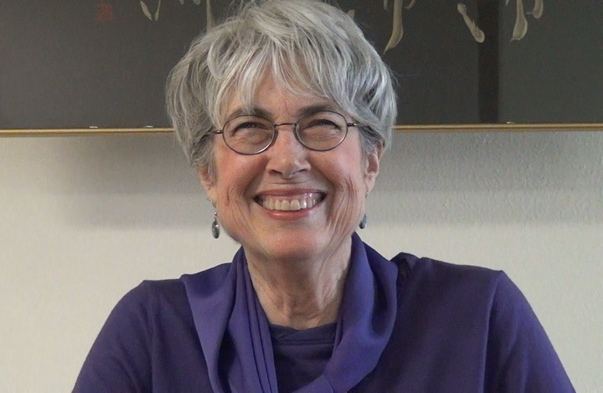
Photograph of Suzanne, 2015; courtesy Jan-Paul Vroom
We mourn the loss of our Natural World editor Suzanne Duarte, who died suddenly of natural causes on December 5, 2015 at her home in Boulder, Colorado.
Originally from California, Suzanne lived for most of her life in the western part of the country where she first came to know and love the wild places of the Earth – the Redwood Forests of northern California, Yosemite National Park, the Colorado Rockies and the Sangre de Cristo Mountains of southern Colorado. They were for her the true mentors teaching us about our interconnectedness with nature, which she later recognized in the deep ecology theory of Arne Naess.
Read the rest of this article »
by Suzanne Duarte

Apollo image of earth; courtesy www.nasa.gov
Nature is stabilized by order, and humans along with all other natural phenomena exist within nature. Attempting to force one’s own path is arrogant, futile and self-destructive.
Lao Tzu
Everything depends on others for survival and nothing really exists apart from everything else. Therefore, there is no permanent self or entity independent of others. Not only are we interdependent, but we are an interrelated whole. As trees, rocks, clouds, insects, humans and animals, we are all equals and part of our universe.
Korean Zen Master Samu Sunim
Dharmagaians (1) are people who seek and speak the truth, cherish and protect the Earth, and act responsibly for the benefit of future generations of all sentient beings. They are not afraid to engage with the truth, the facts of our time, no matter how difficult and painful. In fact, many Dharmagaians have been doing so in writing and teaching for decades. Dharmagaians are also not afraid to allow themselves to feel the suffering of beings living now and those yet to be born, who will inherit a depleted planet.
One Dharmagaian ally, the cosmologist Brian Swimme, tells us that we are living in the most destructive moment in 65 million years. The Earth is withering under the onslaught of humans: our consumption of the biological and mineral endowment of the planet, and our pollution and waste. Species are going extinct at an unprecedented and increasing rate. Resources are declining and shortages are beginning to manifest in the parts of the world that are not already suffering them.
Read the rest of this article »