by Sita Kapadia
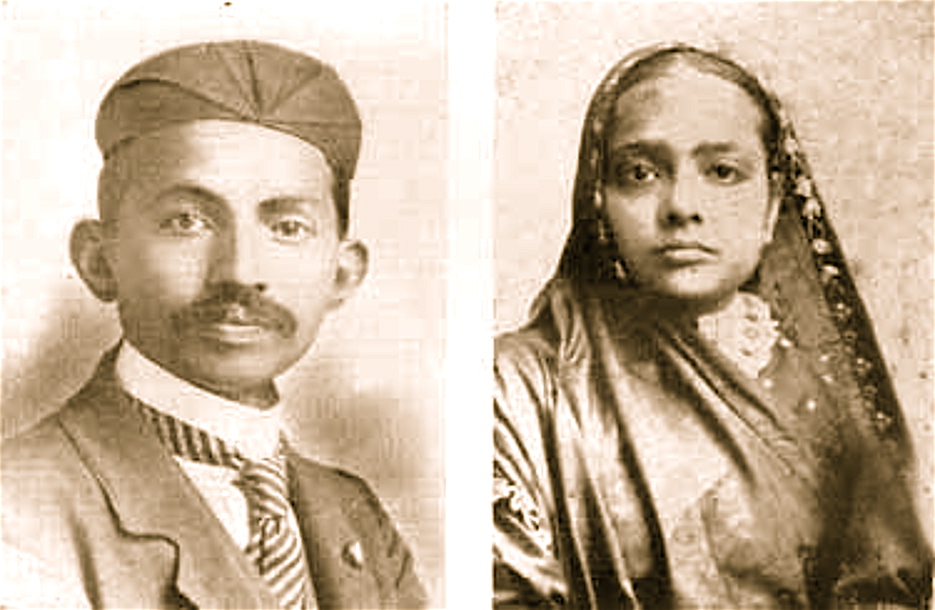
M. K. Gandhi and wife, Kasturba, 1902; courtesy en.wikipedia.org
Mahatma Gandhi’s legacy to the world is immeasurable; his life and work have left an impact on every aspect of life in India; he has addressed many personal, social and political issues; his collected works number more than one hundred volumes. From these I have gleaned only a few thoughts about women and social change.
In 1940, reviewing his twenty-five years of work in India concerning women’s role in society, he says, “My contribution to the great problem lies in my presenting for acceptance truth and ahimsa (nonviolence) in every walk of life, whether for individuals or nations. I have hugged the hope that in this woman will be the unquestioned leader and, having thus found her place in human evolution, will shed her inferiority complex … Woman is the incarnation of ahimsa. Ahimsa means infinite love, which again means infinite capacity for suffering. And who but woman, the mother of man, shows this capacity in the largest measure? … Let her translate that love to the whole of humanity … And she will occupy her proud position by the side of man … She can become the leader in satyagraha.”
Read the rest of this article »
by Rev. Nichiko Niwano
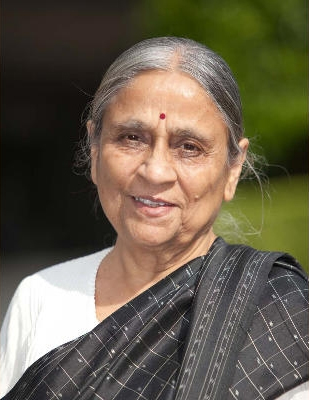
Portrait of Ela Ramesh Bhatt courtesy www.npf.or.jp/english
Editor’s Preface: This interview was conducted upon the award of the 2010 Niwano Peace Prize to Ela Ramesh Bhatt, founder of the Self-Employed Women’s Association (SEWA), an Indian women’s labor union with more than 1.2 million members. She was cited for having worked for “more than thirty years to improve the lives of the poorest and most oppressed women workers.” Rev. Nichiko Niwano is president of the Niwano Peace Foundation in Tokyo, which manages the prize. Please consult the note at the end for further biographical information, acknowledgments, and links. JG
Niwano: I have been particularly impressed by the fact that your activities promoting self-reliance for female workers are based on the spirit of nonviolence. Efforts for social reform always arouse opposition. If we look at history, there have been a great many confrontations wherein “blood washes blood” in cycles of violence. At present, violence swirls around the world. I think that within this context, your work clears a new pathway to the future. Furthermore, you do not view women simply as “the weaker sex”. You have said that “women are the key to the formation of society” and that “women must become the leaders of social change”. These are extremely important messages as we consider the future. Although I am meeting you for the first time, I have very much looked forward to having this dialogue with you, and it is a great pleasure to greet you.
Bhatt: First of all, thank you very much, and I’m really very pleased and grateful that the Niwano Peace Prize of Japan has recognized the courage and the hard work of my SEWA sisters in India. They are trying to build a peaceful society based on constructive work. Personally, the prize is humbling, and makes me more conscious of the immensity of the challenges before us. I realize that life is short and art is long.
Read the rest of this article »
by Raghavan N. Iyer

Poster illustration courtesy en.wikisource.org
Most political and social thinkers have been concerned with the desirable (and even necessary) goals of a political system or with the common and competing ends that men actually desire, and then pragmatically considered the means that are available to rulers and citizens. Even those who have sought a single, general, and decisive criterion of decision-making have stated the ends and then been more concerned with the consequences of social and political acts than with consistently applying standards of intrinsic value. It has become almost a sacred dogma in our age of apathy that politics, centred on power and conflict and the quest for legitimacy and consensus, is essentially a study in expediency, a tortuous discovery of practical expedients that could reconcile contrary claims and secure a common if minimal goal or, at least, create the conditions in which different ends could be freely or collectively pursued.
Read the rest of this article »
by Anil Nauriya
When I am contradicted it arouses my attention, not my wrath.
I move towards the man who contradicts me: he is instructing me.
The cause of truth ought to be common to us both. Montaigne
The debates on Gandhi’s role as a personality and as a symbol of Indian nationalism will go on; the purpose of this article is mainly to draw attention to some points of methodology which, when overlooked, lead to erroneous and even absurd results.
First, analysis confined to comparing the positions of any individuals or organizations at a single arbitrarily chosen point in time is inadequate. Gandhi as well as his critics were continually evolving. The movement in their positions is often of more significance than their points of view at any isolated moment.
Read the rest of this article »
by Sean Chabot

Dust jacket courtesy Oxford University Press; global.oup.com
In her preface to the 1965 edition of Conquest of Violence (see References at the end), Joan Bondurant makes a strong case for distinguishing nonviolent action as duragraha or Gandhian satyagraha. She argues that duragraha involves pressuring opponents based on a de facto prejudgment that they are wrong, through passive resistance, and through symbolic violence. In a later essay (posted previously here), she adds that it is a form of stubborn or willful resistance seeking to demonstrate that opponents are necessarily wrong; that resisters are inherently righteous; and that the purpose of nonviolent action is to gain predetermined objectives by winning battles with opponents. In contrast to satyagraha (i.e., firmness in seeking truth through the power of love), duragraha aims at gaining tangible concessions from power-holders in the short-term rather than transforming social relationships and creating in the long run alternative ways of life benefiting everyone, especially the most oppressed. Bondurant emphasizes these distinctions, because she feels that most of the so-called Gandhian struggles during the 1960s are actually examples of duragraha, not satyagraha. In her eyes, this misunderstanding severely limits the political, ethical, and transformative potential of these struggles.
In the 1960s, Gene Sharp—the undisputed pioneer of nonviolent action and civil resistance studies—responded very differently to Gandhi’s legacy. Unlike Bondurant, Sharp invokes Gandhi to define nonviolent action as “a technique used to control, combat and destroy the opponent’s power by nonviolent means of wielding power”, without carefully conceptualizing satyagraha or considering how it diverges from duragraha (Sharp 1973: 4). By erasing these differences, and by focusing on conventional power politics instead of situational ethics, his The Politics of Nonviolent Action articulates a generic and simplistic understanding of nonviolent action that applies to many cases of unarmed resistance throughout history and across the world. In the process, he normalizes duragraha as a pragmatic and strategic form of nonviolence, thereby hollowing out Gandhi’s concept of satyagraha while continuing to use Gandhi’s name to popularize his own approach. Since the 1970s, Sharp has quickly become the most influential figure in the field, serving as mentor to fellow civil resistance authors like George Lakey, Peter Ackerman, Jack Duvall, Michael Randle, Howard Clark, April Carter, and of course Mary King.
Read the rest of this article »
by Chandi Prasad Bhatt
Editor’s Preface: This previously unpublished paper, from the War Resisters’ International archive, was presented at the Nonviolence and Social Empowerment conference held in Orissa, India, February 2001. Further biographical information, acknowledgments, and archival reference can be found at the end. See also Mark Shepard’s article about Bhatt and Chipko, posted here at this link. JG
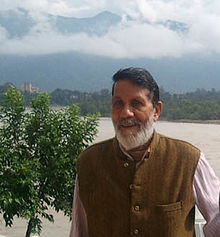
Photograph of Bhatt courtesy en.wikipedia.org
Mahatma Gandhi’s concept of self-governance (swaraj) aimed to create an egalitarian society. To achieve it, a committed group of people established Dasholi Gram Swarajya Mandal (Society for Village Self-Rule; DGSM) at Gopeshwar, northern India, in 1964. Since the objective was to develop a self sustaining nonviolent society, training was offered in village industries, agriculture, horticulture, animal husbandry, harvesting forest produce, utilizing mineral resources, employment in various construction activities, educating and awakening people for forest protection, husbanding of natural resources, etc. Gradually, DGSM become a symbol of village self-reliance. However, everything changed in 1970 when a massive flood hit the Alaknanda river basin, devastating the normal life and destroying the property. The flood was unprecedented in the history of the region, and was described by the government as a natural calamity. But the relief workers of DGSM refused to accept this, as they had witnessed the destruction of the forests between 1950-1970 in the watersheds from where the flood originated. While undertaking the relief operation in the flood-affected watersheds, DGSM volunteers concluded that the flood was more man-made than claimed.
Read the rest of this article »