Archive for December 2015

Three Fairytales by Manfred Kyber

Translated by William J. Jackson
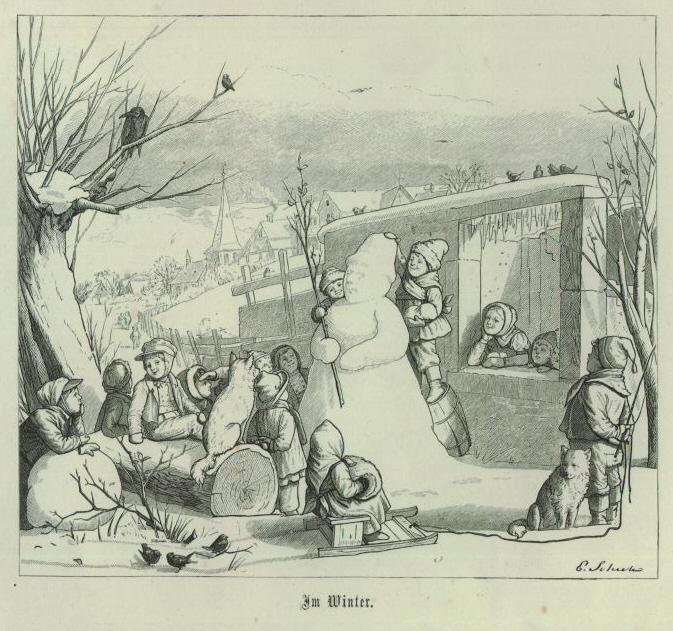
“Wintertime”; illustration by Eduard Schultz, 1867; courtesy commons.wikimedia.org

Translator’s Preface: Manfred Kyber (1880-1933) was born in Riga, now the capital of Latvia, but then a part of Russia. His family was German and when he was still a small boy they moved back to Germany. He studied philosophy at the University of Leipzig and later moved to Berlin where he published a novel, poetry, and theater criticism. He married Elisabeth Boltho, a Theosophist through whom he met Rudolf Steiner, the Austrian philosopher and mystic, and became associated with the anthroposophical movement, which Steiner led. Kyber was not only a pacifist but an outspoken early proponent of animal rights. As well as poetry and novels, he published several volumes of fables and fairy tales, many of which have been translated into English. See the note at the end for links and further details about the translation and translator. Please note that we have also posted three other fairy tales by Kyber. WJJ

◊   ◊   ◊

The Snowman

Once upon a time there was a snowman who stood in the middle of the deep snow-covered forest, and he was made entirely of snow. He had no legs, and his eyes were made of coal—that’s all he had, and that’s not much. And he was cold, terribly cold. That’s what the grumbling old icicle that hung nearby said too, though he himself was even colder. “You are cold,” he said reproachfully to the snowman.

The snowman was hurt. “Well, you’re cold too,” he answered.

“Yes, but that’s something else again entirely,” said the icicle with a superior tone.

The snowman was so offended that he would have gone away if he had had any legs. But he had no legs and so he remained standing there, though he did decide to speak no more with the unfriendly icicle.
Read the rest of this article »

Columbian Nonviolence Group 40 Years On

by Stephan Brües

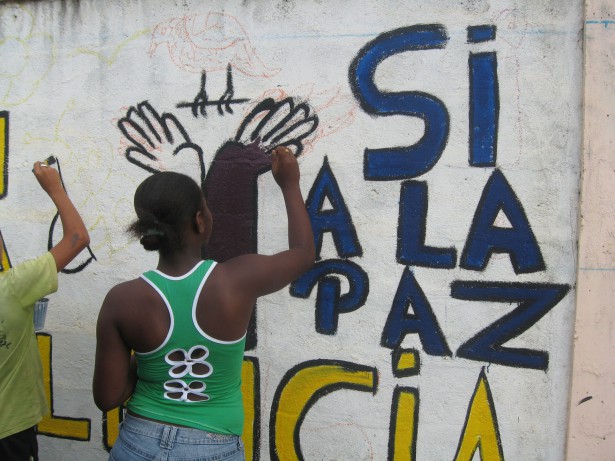
Youths in Ecuador painting peace symbols; courtesy wagingnonviolence.org

Editor’s Preface: We have previously posted, from the War Resisters’ International archive, two historical articles about nonviolent resistance in Latin America, which can be accessed at this link. This article updates the information, and the struggle. Please consult the Editor’s Note at the end for further biographical information and acknowledgments. JG

Blas Garcia Noriega, a small man who wears glasses, is thoughtful and vivid, especially when he talks about his activities with Servicio Paz y Justicia, or SERPAJ. Founded 40 years ago in Medellin, Colombia, SERPAJ promotes nonviolent resistance and peaceful conflict resolutions throughout Latin America.

“SERPAJ is not an NGO, but a social movement,” Garcia said. “We are doing big things with little resources.” In words like these, it is possible to hear the challenges of this kind of work and the pride he takes in doing it. Peace activists like Garcia who oppose all forms of violence — whether from the state, guerrillas, drug sellers or militias — are caught between many armed groups in Colombia.

Read the rest of this article »

Alagamar: Nonviolent Land Struggle in Brazil

by Hildegard Goss-Mayr

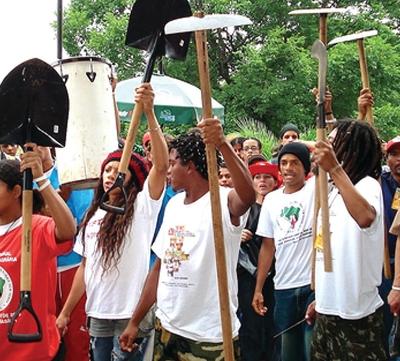
Brazilian farmers’ nonviolent land protest; courtesy mettacenter.org

Editor’s Preface: The following, previously unpublished essay was presented to the Alternative Defense Commission, as part of the War Resisters’ International Peace Education Project, c. 1987. It continues our series of discoveries from the WRI archive.  Please see the notes at the end for archival reference, as well as acknowledgment and biographical information about the author. JG

In most Latin American countries military or civilian dictatorships, on the basis of the doctrine of national security, continue to uphold an economic system of exploitation that favors a small group of privileged individuals (as well as national and multinational corporations in the First World) and condemns the vast majority of the people to a life of dependence, misery, and political and social marginalization. But the masses of the poor in Latin America have increasingly become aware of their human rights and dignity, and in many parts of the continent, despite violent and brutal repression, they have begun to organize and struggle for change. Popular civic movements are springing up and pressing for justice.

Read the rest of this article »

Firmezza Permanente: Nonviolence in Central America

by Matt Meyer

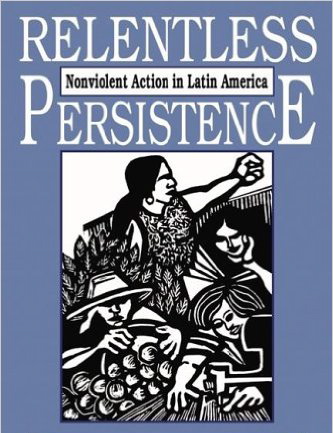
Book jacket art courtesy wipfandstock.com

Editor’s Preface: The following, previously unpublished essay was presented to the Alternative Defense Commission, as part of the War Resisters’ International Peace Education Project, c. 1987. It continues our series of discoveries from the WRI archive.  Please see the notes at the end for acknowledgment, archival reference, and biographical information about the author. JG

To many western activists it may seem that revolution and nonviolence are clear contradictions. Nonviolence is often seen as passive, utopian, naive, or as a bourgeois luxury that we in the West arrogantly urge upon our Central American sisters and brothers. However, revolutionary nonviolence is not passive, reformist, or romantic. It is a powerful means of social change, which confronts the roots of militarism; its use in Central America has often been ignored.

Western pacifists may well be challenged about their commitment to nonviolence even in the war zones of Central America. “What do you know?” someone might ask. What we know, and what we believe history has taught us, is that revolution is a long process, with many difficult questions and no easy answers. We know that to strive for an end to war, we must first struggle for the elimination of the causes of war, including racism, sexism, class structures, and imperialism. We know that any revolution, including nonviolent revolution, will suffer bloodshed and innocent casualties, and we continue to experiment with diverse forms of resistance to minimize bloodshed and maximize lasting social change. Above all, we know that we cannot begin to talk about nonviolent revolution until we place ourselves firmly in solidarity with those already in revolutionary struggles throughout the world.

Read the rest of this article »

Nonviolent Common Defense: The Biography of an Idea

by Gene Keyes

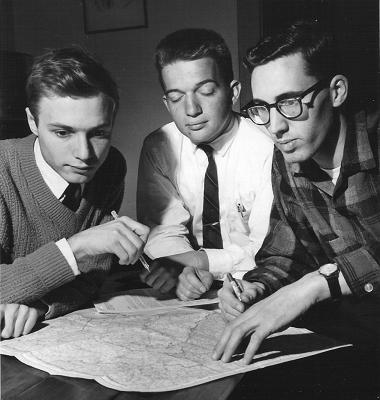
Gene Keyes, Dennis Weeks, and Joe Tuchinsky planning 1964 civil rights march route to Albany, Georgia

Editor’s Preface: The topic of nonviolent civilian defense was high on the agenda of the peace and nonviolence movements in the 1970s and 1980s. This essay is representative of that discussion, and is another in our series of discoveries from the War Resisters’ International archive. The article appears to be Chapter Two of the author’s “unpublished” PhD thesis for Toronto University; a pdf scan of the original is attached. Please also consult the notes at the end for archival reference, acknowledgment, biographical information about the author, and a link to his site. JG

The idea we are considering has had numerous names since the 1850s, and especially since the 1950s: passive resistance; nonresistance; nonviolent resistance; civil resistance; unarmed defense; nonviolent defense; nonmilitary defense; civilian defense; civilian resistance; nonviolent civilian defense; social defense; civilian-based defense; societal defense; post-military defense; etc..

An expression I would like to try out is “common defense,” but reinvigorated to mean an effort mounted by an entire polity using the nonviolent means at hand; with defiance and organization; with strategy, principle, and tenacity: common defense of everyone, by everyone, for everyone; common defense without nuclear weapons, firepower, or any other killing and violence; common defense as workaday resistance by an unconquerable free people.

Read the rest of this article »


hrule
“When planted in the garden, the mustard seed, smallest of all the seeds, became a large tree, and birds came and made their home there.” Luke 13:19

“For me whatever is in the atoms and molecules is in the universe. I believe in the saying that what is in the microcosm of one’s self is reflected in the macrocosm.” M. Gandhi