by Theodore Olson
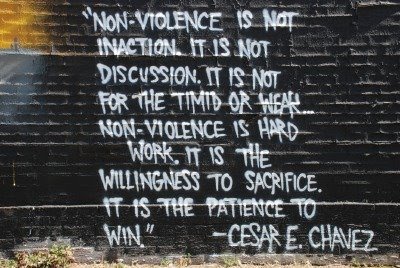
Poster art courtesy occupysantacruz.org
Editor’s Preface: This unpublished essay was a paper presented at the study conference Training in Nonviolence (Perugia, Italy, 13-20 August 1965) under the joint auspices of War Resisters’ International, and is another in our series of rediscoveries from the WRI archive. Please see the notes at the end for further archival references, a link to a pdf scan of the original, and biographical information about the author. JG
By nonviolent training we mean conscious attempts, in the context of teaching and learning, to impart historical experience, general concepts, technical skills and personal experience in how to act effectively and nonviolently in conflict situations. By “nonviolently” we mean to stress programmatic or active nonviolence, as exemplified by, but not restricted to, social action struggles: for example, Gandhi’s actions in India and that of the peace and civil rights activists in the United States.
Read the rest of this article »
by Theodor Ebert
Editor’s Preface: This unpublished essay, by an eminent Christian pacifist and theorist, was a paper presented at the Study Conference on Nonviolent Solutions of Conflict with Special Reference to Germany and Berlin. It was held in Offenbach, Germany, in August 1964 under the joint auspices of War Resisters’ International, and is another in our series of rediscoveries from the WRI archive. Please see the notes at the end for further archival references and biographical information about the author. JG

Image courtesy vjai.com
In March 1964 a collection of articles was published in London under the title ‘Civilian Defence’ in which Adam Roberts, Jerome Frank, Arne Naess and Gene Sharp discussed the possibilities of meeting invasion or coup d’état by nonviolent resistance. Adam Roberts in his introductory contribution states, ‘All the authors of the articles in this booklet consider that nonviolent action should be judged not in terms of a doctrine, which one may accept or reject, but as a technique, the potentialities of which in particular situations demand the most rigorous and careful study.’
It should be the task of science, even at the risk of shocking public opinion and making ‘creative misunderstandings’ more difficult, to reveal the doctrinal background of such a technique, i.e. to explain the ideas of the leaders of nonviolent resistance campaigns who, in deference to the outside world, pretended to be mere technicians of nonviolent action or who, at best, called themselves ‘practical idealists’ with the accent on ‘practical’.
Read the rest of this article »
by Melanie Nakashian
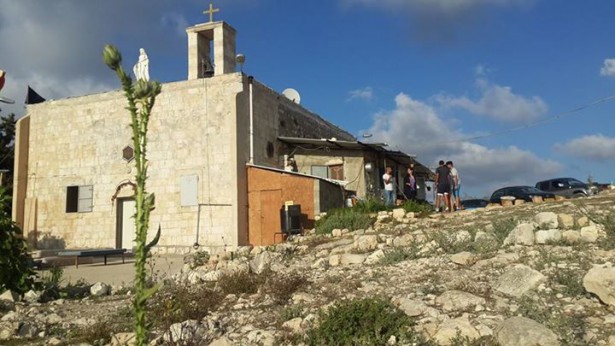
St. Mary’s church, Iqrit; courtesy wagingnonviolence.org
Editor’s Preface: The story of the decades-long nonviolent protest in the village of Iqrit, northern Israel, is one we have previously covered, and can be found at this link. Indeed, our previous article, from our WRI research project, was written in 1974, to cover a nonviolent protest that had already been going on for several years. That the inhabitants have resorted to the courts and symbolic acts of protest such as planting trees and gardens, but have remained nonviolent, is one of the more remarkable stories of contemporary nonviolent protest. JG
Among the hundreds of Palestinian villages that were evacuated between 1947 and 1951, there is one whose descendants are actually getting close to fulfilling their right of return. In an unprecedented case, the demolished Christian village of Iqrit should soon be connected to Israel’s electricity grid. This comes just as a group of Iqrit’s young descendants mark three years, this August 5 [2015], of continuously inhabiting the church in their otherwise destroyed village.
Read the rest of this article »
by Judith Mahoney Pasternak
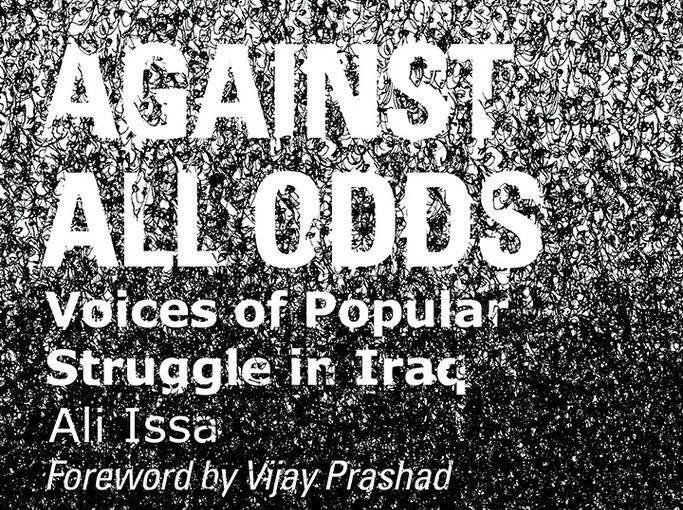
Book jacket art courtesy tadweenpublishing.com
If you follow the Western media, the news from Iraq is almost always bad. A quarter century of war, including 13 years of brutal sanctions, invasion, a no less brutal eight-year occupation, an externally imposed, undemocratic and repressive government, and now the attempt by the Islamic State to remake Iraq in its image — all have resulted in millions of deaths, and the toll keeps rising. “Such a bruised country! No society can withstand such pressure,” declares Indian journalist Vijay Prashad in his foreword to Against All Odds: Voices of Popular Struggle in Iraq [Washington, D.C. and Beirut: Tadween Publishing, 2015].
Yet there is another side to the story of Iraq, one that has been rendered all but invisible in the media, which seem to have no room for the words “hope” and “Iraq” in the same sentence. In February of 2011, in the wake of the Arab Spring, the hunger for a better future for Iraq — a hunger that had been repressed but never suppressed — arose again in force in cities across the ravaged country, in the form of a decentralized mass nonviolent protest movement. Against All Odds is the story of that movement, told in part by War Resisters League organizer and writer Ali Issa, and in part by eight leaders of different segments of that movement.
Read the rest of this article »
by Nirmal Kumar Bose
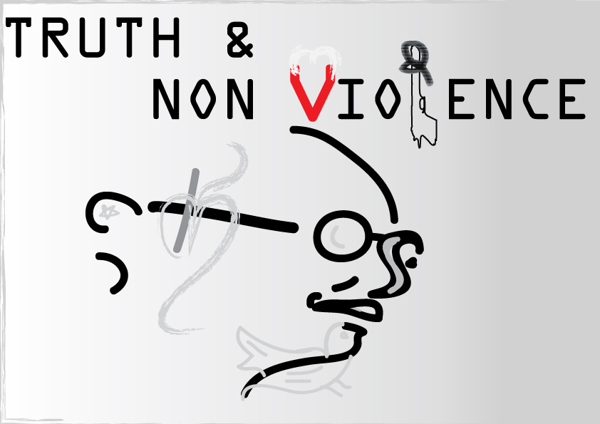
Illustration art courtesy behance.net
Editor’s Preface: This article is the text of a speech delivered at the World Pacifist meeting in Shantiniketan, India, 1-5 December 1949, and continues our War Resisters’ International archive series. Nirmal Kumar Bose was an important figure in Gandhi’s life in the 1930s and 40s, and the author of an important diary of his life in Gandhi’s ashrams. For more biographical details please see the Editor’s Note at the end, along with an archive reference and a link to a pdf reproduction of the entire, original article. JG
India has tried to follow the principles of satya and ahimsa, truth and nonviolence, through centuries of her history. The actual application of these concepts has varied over the centuries and they have also been successfully employed in the solution of numerous problems relating to personal life or even group-life, where the group was based upon common religious experience.
Read the rest of this article »
by Purushottama Bilimoria
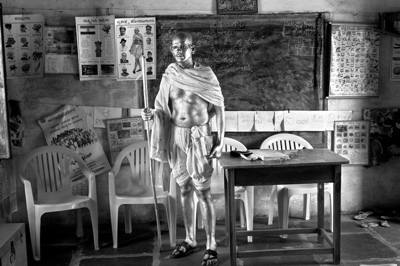
Indian actor Bagadehalli Basavaraju poses in classrooms as living statue of Gandhi; courtesy thebetterindia.com
Mohandas Karamchand [Mahatma] Gandhi adopted the metaphysics of a broadly-conceived Hindu religious thought for his social critique, out of which he developed a distinctive educational philosophy, which gave particular emphasis to truth and nonviolence, or the teaching of peace. In his social thinking he gave immense importance to what he called a ‘balanced’ form of education. By this he meant balanced as to needs, i.e. the necessities of life, against wants, i.e. whatever one yearns to possess, acquire or enjoy out of desire; and, more significantly, balanced as to internal values against a disproportionate concern with the externals (1948: 52). By ‘externals’ is meant the goods people generate and the sorts of activities, planning and manoeuvres people carry out in the normal course of living in order to meet the demands of commerce, material accessories, personal welfare and reproduction, and which are at the same time instrumental in sustaining the community.
Read the rest of this article »
by Stephen Zunes and Noor Al-Haidary
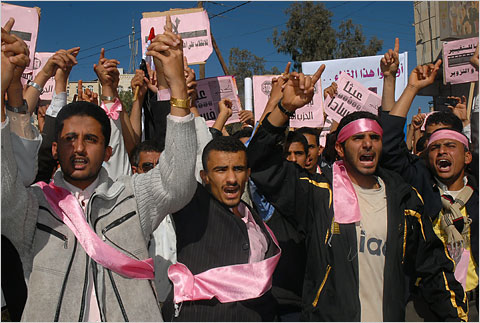
Yemeni protesters wear pink as symbol of nonviolence; courtesy went2thebridge.blogspot.nl
As with the 2011 uprising against the Saleh regime in Yemen four years ago, an unarmed civil society movement is now (April 2015) rising up to challenge the Huthi militia. While media coverage of the tragic situation unfolding in Yemen in recent months has focused on armed clashes and other violence, there has also been widespread and ongoing nonviolent civil resistance employed by a number of different actors. In fact, the most significant setbacks to the Huthi militia in their march southward across the country in recent months have come not from the remnants of the Yemeni army or Saudi air strikes, but from massive resistance by unarmed civilians which has thus far prevented their capture of Taiz, the country’s third largest city, and other urban areas. The resistance efforts have also pressed the Huthi to withdraw their forces from a number of previously held areas, including universities, residential neighborhoods, and even military bases. This kind of nonviolent resistance by ordinary people is remarkable, but it is not new in Yemen.
Read the rest of this article »
by Paul Rogers
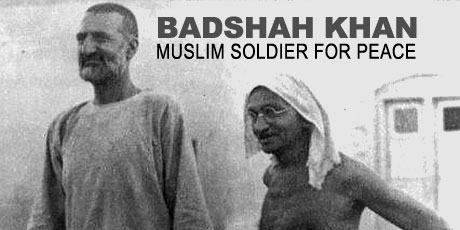
Badshah Khan wih Gandhi; photograph courtesy stopwar.org.uk
The story of Badshah Khan, told in Heathcote Williams’ new book, Badshah Khan: Islamic Peace Warrior, London: Thin Man Press, 2015, is a powerful antidote to Islamophobia. Anyone who has also seen Richard Attenborough’s film Gandhi will remember the vivid depiction of the Amritsar massacre in April 1919 when British and Gurkha troops under the command of General Reginald Dyer opened fire on unarmed protestors and killed well over 350 people. It was one of the worst atrocities committed by the British in India, but far from the only one.
Read the rest of this article »