by Barbara E. Addison
Editor’s Preface: We previously posted Reynolds’ article, “The Practical Application of Nonviolence,” as part of our War Resisters’ International project, found at this link. Both that article and this are additions to our ongoing series on Gandhi’s influence on pacifist and nonviolent movements in Europe and the U.S. Please consult the note at the end of the article for further information about the author. JG
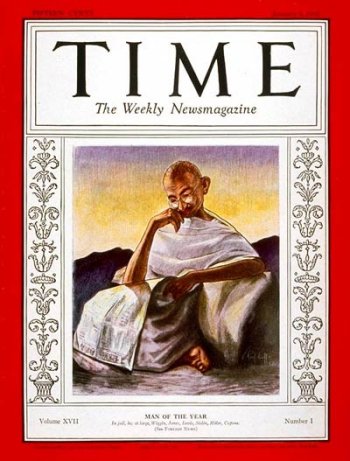
“Gandhi: Man of the Year”; Time, Jan. 5, 1931; courtesy www.kamat.com
Reginald Reynolds, a young British Quaker, corresponded with Mohandas K. Gandhi during one of the most crucial periods in Gandhi’s life and in modern Indian history: the Salt March (Salt Satyagraha) and the beginning of the 1930 Indian civil disobedience campaign against the British Raj. Reynolds was a resident in Gandhi’s ashram (spiritual retreat) at Sabarmati from 1929 to 1930. In March 1930, Gandhi appointed him to deliver a lengthy statement (generally known as “Gandhi’s Ultimatum”) to the British viceroy explaining the reasons for Gandhi’s revolt against British authority. The Gandhi-Reynolds correspondence, written primarily between 1929 and 1932, reveals Gandhi as an indefatigable political strategist, spiritual leader, and warm, attentive friend.
In 1931, Reynolds sold three of his Gandhi letters to Charles F. Jenkins, a prominent Philadelphia businessman and manuscript collector. He was parting with the correspondence in order to raise funds for his British-based organization, “The Friends of India.” He told Jenkins: “I find myself able to help them by surrendering some of my most valued possessions,” adding that he had many other letters, but had selected these as the ones with which he felt he could best part. “The rest are far too personal and precious to part with at all, and a fortune would not purchase them!” (1) The letters apparently were left to the Swarthmore College Peace Collection in Jenkins’s will, and were added to the collection in 1952. Reynolds himself donated sixteen of his “personal and precious” letters to the Peace Collection some time between 1952 and his death in 1958. Barbara Addison’s article, including scans of all the original documents, may be accessed at this link, “Gandhi Letters in the Swarthmore College Peace Collection.” (2)
Read the rest of this article »
by Metta Spencer
Book jacket courtesy Oxford University Press; global.oup.com
Metta Spencer: It has been eight years since I last interviewed you for the magazine. Since then people around the world have begun to listen to you.
Gene Sharp: Yes, I was just now invited to a Washington journal — Foreign Policy — who will publish something about people who had some response in the world in the last year. That kind of invitation never happened a few years ago.
Spencer: I know. In fact, let’s begin by reviewing the changes in your own thinking. As I recall, you started off as a graduate student in sociology working on a masters thesis and have managed to turn into Gene Sharp, the guy on the front page of the New York Times. Let’s start at the time when you began to realize that nonviolence was a special set of practices that could be developed into useful procedures.
Sharp: Ah yes! One thing that was in the master’s thesis was a typology of nonviolence. I classified six or seven belief systems, of which one was called “nonviolent resistance.” That’s a different category but it was in with the others. (Today I don’t even like the term “nonviolence” except for very special uses.) That typology went through several revisions and one was published in the Journal of Conflict Resolution, which was an entirely new publication at the time. In it I took out nonviolent struggle as a separate category. That was a breakthrough in my thinking — that people didn’t have to have the belief in order for them to act.
I remember one time in the basement of the Ohio State University library. I was looking through old Indian newspapers on the conflict — I think it was the 1930 campaign — and the evidence was there: These people did not believe in nonviolence as an ethic! That was a shock. I thought: Oh dear! We didn’t have copy machines then. I had to copy the whole thing by hand and I thought; should I copy that down? It’s not supposed to be that way. But my focus on reality won out, fortunately, and I copied it down. Later I realized that it wasn’t a problem. It was a breakthrough, an opening! People didn’t have to believe in order to use this form of action! Therefore, it was open to almost everybody. That breakthrough was in about 1950 or ’51.
Read the rest of this article »
by Meir Amor
Meir Amor: About 15 years ago you and I had a discussion that was published in Peace Magazine. The editors of Peace think it would be good to have another talk. So let me ask you first: Does your approach to nonviolence have a religious basis? Do Jewish or Muslim religious authorities consider it compatible with their teachings?
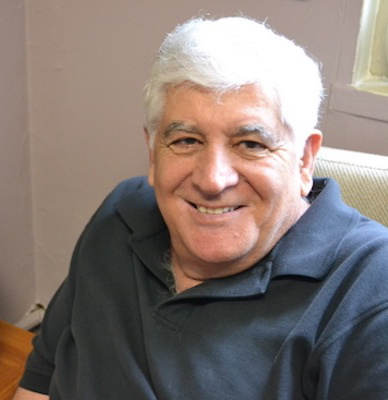
Photo of Mubarak Awad, 2014, by Meir Amor; courtesy nonviolenceinternational.net
Mubarak Awad: Personally, I do it from a Christian perspective. For me, it’s time for us all to learn not to kill or destroy. But I did not push that belief on any Israelis or any Muslims. However, I did study Islam and nonviolence a lot, and I thought it would be great to have a Muslim who was interested in nonviolence so we could have a strong campaign. At that time I was interested in Faisal Husseini (1), a great Muslim who believed in nonviolence. I bought a lot of books about a Muslim who had been with Gandhi — Abdul Ghaffer Khan (2), who said that Islam is a nonviolent religion. I was doing that because the majority of Palestinians are Muslim. We held conferences studying Islam and nonviolence — discussing what jihad really means and Sufism in Islam. Sufis are like the Quakers in Christianity; they believe in peace.
There are many Sufis in Islam, who accept the challenge of nonviolence. It’s a big struggle for them — not only between the Palestinians and Israelis or Arabs and Israelis, but also between themselves, for them to be nonviolent at home and active in nonviolence in their community. They can see that we human beings have brains, not just guns, and can resolve any conflict, however big, by debating, by forgiveness, by conciliation.
But in the past twenty years the world has moved toward radical religion in Islam, Christianity, and Judaism. That allows a minority within each religion to start dictating what religion means in a fundamentalist way. Many Muslims want to go back to a caliphate or to Mohammed. Some of them want to be more fundamentalist or more conservative.
Read the rest of this article »
by Meir Amor
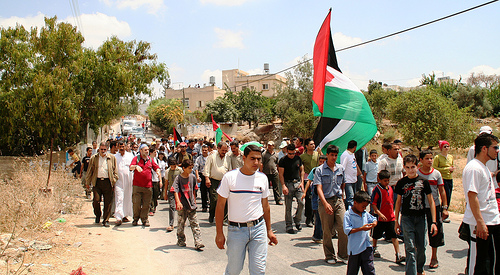
Palestinian nonviolence marchers, Bil'in Village. Credit: Creative Commons/Michael Loadenthal; courtesy tikkun.org
Meir Amor: Why did you become a leader in the nonviolent Palestinian struggle?
Mubarak Awad: Palestinians had hardly any understanding of nonviolence. Gandhi had not been given a lot of attention in the Muslim world because he was against the creation of Pakistan, an Islamic state. So in the Arab mind nonviolence is just surrendering to the one who has more power.
Before I was expelled from Israel in 1988, my first initiative with Palestinians was to try to develop an educational program of nonviolence in Islam. I went to India to find a Muslim who worked with Gandhi: Abdul Ghaffar Khan, (1) who brought his village of Pathans into a struggle, forming a nonviolent army to help Gandhi. I wrote a book about him and met with religious leaders in Palestine, Israel, and Egypt. I found interested Muslims — most of them Sufis. In Islam, the Sufis are like Quakers in Christianity. In some places they are regarded as heretics. They pray; they dance; they act as if they have oneness with God. In Islam you cannot do that, so the Sunnis and Shiites don’t accept them as real Muslims. They are the ones who started writing about Islam and nonviolence.
Read the rest of this article »
by Terry Messman
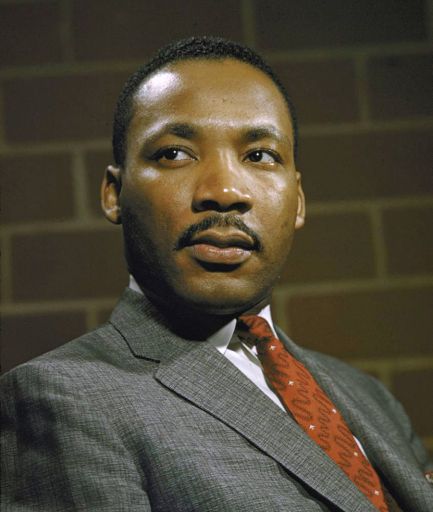
Martin Luther King, Jr.; courtesy thestreetspirit.org
Two of the most inspiring currents in modern American history came together when Muddy Waters and his electrifying Chicago blues band traveled to Resurrection City in Washington, D.C., on May 18, 1968, to play a benefit concert for the poor people and civil rights activists camped out in a shantytown in the shadow of the Lincoln Memorial.
Both of the mighty rivers that converged on that fateful day in the nation’s capital — the river of song and the river of justice — had their headwaters in the state of Mississippi, in two of the nation’s most poverty-stricken areas.
The river of song had its source at the ramshackle wooden shack where Muddy Waters lived and labored and first played the blues; while the river of justice had its headwaters in Marks, Mississippi, the small town in Quitman County where Martin Luther King, Jr. first saw the full extent of childhood poverty and hunger.
“Justice is like a Mighty Stream”
The two rivers had joined together in Resurrection City, the encampment created by the Poor People’s Campaign in May 1968. One of Dr. King’s most oft-cited passages from the prophet Amos likens justice to a “mighty stream.” Five years earlier, Dr. King had delivered his “I Have a Dream” speech at the massive March on Washington in August 1963 while standing at the same location where Resurrection City now stood. He had quoted Amos in his speech: “Let justice roll down like waters and righteousness like a mighty stream.”
Read the rest of this article »