Archive for December 2014

The Little Fir Tree: A Fairy Tale

by Manfred Kyber

Editor’s Preface: Manfred Kyber (1880-1933) was born in Riga, now the capital of Latvia, but then a part of Russia. His family was German and when he was still a small boy they moved back to Germany. He studied philosophy at the University of Leipzig and later moved to Berlin where he published a novel, poetry, and theater criticism. He married Elisabeth Boltho, a Theosophist through whom he met Rudolf Steiner, the Austrian philosopher and mystic, and became associated with the anthroposophical movement, which Steiner led. Kyber was not only a pacifist but an outspoken early proponent of animal rights. As well as poetry and novels, he published several volumes of fables and fairy tales, many of which have been translated into English. See the note at the end for links and further details about the translation and translator. Please note that we have also posted two other fairy tales by Kyber, “The Daily Work before Sunrise”, and “The Key of Heaven”.  WJJ

Illustration courtesy damaridemarangelli.carbonmade.com

Once upon a time, deep in a forest of firs, there was a little fir tree who yearned to be a Christmas tree. But that is not as easy as most things in the community of trees, because Saint Nicholas is very firm in regard to his policies, and allows only those trees which have been duly recorded in his book to go into towns and cities as Christmas trees.

The book is frightfully thick, as is proper for a good old saint, and Saint Nicholas takes it with him into the woods on clear cold winter nights and records which trees are to be chosen for the Christmas celebrations.

And the trees, thrilled that they have been chosen for Christmas Eve festivities, bow before him in gladness to thank him, and then the saint’s halo glows, and that is very beautiful, and very solemn.

Now this little fir tree deep in the forest of firs yearned to be a Christmas tree. But for many years Saint Nicholas, when passing by the little fir tree in the clear cold winter nights, had said nothing, absolutely nothing. The poor little fir tree had not been noticed, and so he became very, very sad, and began weeping and weeping, and all his branches trickled with tears.

When someone weeps so much that he begins trickling, someone is bound to hear it. Indeed, this weeping could be heard by a small gnome. He wore a green moss cloak, had a grey beard, and a flame-red snout, and lived in a dark hole.
Read the rest of this article »

The Key of Heaven: A Fairy Tale

by Manfred Kyber

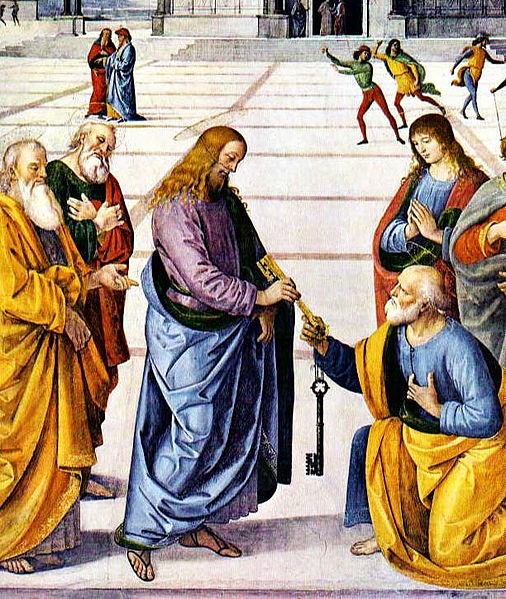
Perugino, “Christ giving Peter the Keys to Kingdom of Heaven”; Sistine Chapel, Vatican.

Once upon a time, there was a very great and powerful king who ruled over many lands. All the treasures of the earth belonged to him, and he sported daily with the precious gemstones of Ophir and the roses of Damascus. But with all his great wealth and his great kingdom, there was still one thing he lacked, and that was the key to the gate of heaven.

He had sent out a thousand messengers to search for the key of heaven, but none could bring it to him. He had asked many wise men who had come to his court where one might find the key of heaven, but none of them had known the answer. Only one, a man from India with strange eyes, who smiled, pushing aside the precious gems of Ophir and the roses of Damascus with which the king sported, said to him: “All the treasures of the earth may be received as presents, but each person must seek individually for the key of heaven.”

Read the rest of this article »

Gandhi in the Postmodern Age

by Sanford Krolick and Betty Cannon

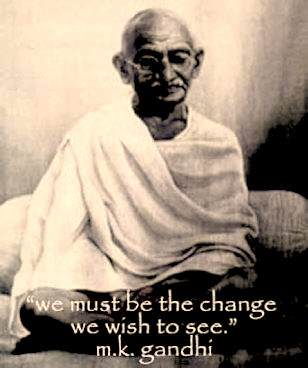
Poster art; courtesy whataboutgandhi.com

The theory of nonviolence as an offspring of democracy is still in its infancy. Mohandas Gandhi, the master of this philosophy and its methods, was educated in Britain as a lawyer and learned well the principles of democracy. Throughout his years in South Africa and in the campaign for Indian independence, his efforts in dealing with conflict were consistent with the basic beliefs of democracy. While others fought revolutions promising that victory would bring democracy, Gandhi brought about revolutions using democratic principles and techniques; his victories were signified by the acceptance of democracy. Gandhi never tired of talking about the means and ends, claiming that the means used in settling the dispute between the Indian people and the British Government would determine the type of government India would evolve. He was fond of saying that if the right means are used, the ends will take care of themselves.

Gandhi called his philosophy satyagraha. In the United States it has been called nonviolence, direct action, and civil disobedience. These terms are inadequate because they only denote specific techniques Gandhi used. However, for the purposes of this discussion, we will use nonviolence to designate the philosophy and resisters to designate those who adopt this philosophy and carry out its methods.

Read the rest of this article »

The Daily Work before Sunrise: A Fairy Tale

by Manfred Kyber

Cover art for Kyber’s fairy tales; courtesy buchladen-joerg.de

Once upon a time, there was a blacksmith’s workshop and a blacksmith who labored there each day.

This blacksmith was unique, because his daily work was finished before sunrise.

It is a very difficult kind of daily work, which this blacksmith does. A person doing this kind of work becomes weary and sad. And one becomes calm and patient because of it, too. This kind of labor takes a lot of strength. Because someone who does this kind of work lives alone, and hammers in the twilight.

Now it was night, and the blacksmith was not at his forge. The fire-spirit in the chimney slept too. Only the fire-spirit’s breath faintly glowed off and on, glimmering under the ashes, and now and then scattering sparks around in the darkness. But the sparkles soon went out. Only a small gleam of light remained, and when it flickered, it cast glowing light beams that seemed to hurry here and there on the floor and walls, as if wandering and seeking something in the darkness of the smithy.

The relaxed bellows let its great stomach hang in plain glum folds, though when it is folded it becomes slimmer. It reminds us of how a stout master can grow skinny all of a sudden. One could have laughed about this, but in the smithy there was no one who understood how to laugh.

The anvil turned his fat head with its sharp pointed nose slowly in each direction, and looked at the old pieces of iron which would be hammered today. It was not much to look at. Only a few worn pieces huddled together. They lay in a corner, and they were dirty and dusty, like folks who have a long and difficult journey behind them.

Read the rest of this article »

The Practical Application of Nonviolence

by Reginald Reynolds

Editor’s Preface: Reginald Reynolds (1905-1958) was a British journalist and general secretary of the London based No More War Movement (1933-37). He was a friend and supporter of Gandhi, and a staunch critic of British imperialism in India, which he articulated in his controversial The White Sahibs in India [1937], and also in Why India [1942]. During WWII he was a conscientious objector, and served in a mobile hospital unit. Reynolds was a great admirer of the American Quaker preacher, John Woolman, whose works he edited for a new English edition, and whom he cites below. See the notes at the end for archival references, and further information. This is the unpublished text of a speech delivered by Reynolds at the seventh triennial WRI conference, Braunschweig, Germany, in July of 1951. JG

Reginald Reynolds c. 1930; courtesy swarthmore.edu

“There is no way to peace, peace is the way.” These words, which were first brought to my attention in a letter received recently, and which I have since seen in an article, have been ringing in my mind ever since I arrived at this conference, and frankly what I am going to say to you now is merely the possibly confused reflections which have been going on in my mind since I read these words.

To me they express, in the most terse and epigrammatic manner, a philosophy, which I have been evolving myself over a period of years. “There is no way to peace, peace is the way”, and I believe that pacifism, as I understand the word, is an attempt to realize, in terms of life, the meaning of that simple epigram.

We are asked continually by non-pacifists, whether we hope, by our methods and by our movement, to prevent war. I don’t know what answer you give – I always say “of course we hope, but we do not expect.” And we do not base our belief in nonviolence on any calculation regarding the possibility of stopping war by a method of war resistance.

Read the rest of this article »

Training for Nonviolent Action

by Don Lorenzo Milani

Don Milani with his students; courtesy www.giovaniemissione.it

Editor’s Preface: Don Lorenzo Milani (1923-1967) was born in Florence and became renowned as an educator of children from poor families, and an outspoken and controversial conscientious objector. His mother, Alice Weiss, was Jewish and a cousin of Edouardo Weiss, one of Freud’s earliest disciples. He was raised as an agnostic, but at the age of twenty he converted to Catholicism and was later ordained a priest. Besides his pacifist writing he also published in 1965, Letter to a Teacher (Lettera a una professoressa), which denounced the inequalities of class-based education systems “favouring the rich over the poor”. The book was in fact written cooperatively by Milani and eight student dropouts, and took a year to complete. It is considered one of the great Italian pedagogical works. In this book and in his classes he insisted on teaching conscientious objection, or what he termed “going against the grain” history. A useful article about Milani may be found at this link. JG

Introduction by Devi Prasad [1965]

Don Milani is an outspoken and intellectual person with deep political understanding. He is a parish priest and lives in Barbiana nearly 50 kilometres north of Florence, a place in the hills not easily accessible. When I went to meet him last August I felt it could not have been just chance that a priest like Don Milani is placed in such an isolated village. I later learnt that Church authorities sent him there after the publication of his book Pastoral Experience. He is perhaps too dangerous to be allowed to live in a central place where many more people can come in contact with him.

Read the rest of this article »

Nonviolence: What It’s About

by Peace Pledge Union

Editor’s Preface: In October 1934, Canon Dick Sheppard, a former British army chaplain, sent an open letter to the London press warning about an impending war. In it he spoke of the, “almost universally acknowledged lunacy of the manner in which nations are pursuing peace”, and went on to add that “the majority of thoughtful men are now convinced that war of every kind, or for any cause, is not only a denial of Christianity, but a crime against humanity, which is no longer to be permitted by civilised people.” War as a crime against humanity was an echo of sentiments already voiced by War Resisters’ International, Paco, and other groups. In the first 2 days after the editorial appeared Sheppard received over 2500 letters in support of his position. A meeting was called at the Albert Hall in London, which led to the founding of the No More War and Peace Pledge Union (PPU) movements. In a statement drafted by Sheppard they pledged, “We renounce war, and never again, directly or indirectly, will we support or sanction another.” This article continues our ongoing series of statements of principles by various movement colleagues. See the note at the end for further information and links. JG

Logo Peace Pledge Union; courtesy ppu.org.uk

Nonviolence means abstaining from the use of physical force to achieve an aim. It is a philosophy, a principle, and a practice. As an ethical philosophy, it upholds the view that moral behaviour excludes the use of violence; as a political philosophy it maintains that violence is self-perpetuating and can never provide a means to a securely peaceful end. As a principle, it supports the pacifist position that war and killing are never justifiable. As a practice it has been used by pacifists and non-pacifists alike to achieve social change and express resistance to oppression. For pacifists, of course, all demonstrations of their view and protests against violence must by definition be nonviolent.

Read the rest of this article »


hrule
“When planted in the garden, the mustard seed, smallest of all the seeds, became a large tree, and birds came and made their home there.” Luke 13:19

“For me whatever is in the atoms and molecules is in the universe. I believe in the saying that what is in the microcosm of one’s self is reflected in the macrocosm.” M. Gandhi