
Archive for April 2013

The Arne Naess Project

by the Editors

With the permission and cooperation of Mrs. Arne Naess, we are posting here Arne Naess’s Gandhian writings. We will also be posting critical writings about Naess’s Gandhian theories. See, for example, Alan Drengson’s biographical and critical article already posted.

The Norwegian philosopher Arne Naess (1912-2009) is one of the foremost environmental thinkers of the twentieth century, often referred to as “the father of deep ecology”. Less well known is that he was also a major theorist of Gandhian nonviolence, or more specifically of active nonviolent resistance, satyagraha. His two Gandhian volumes were published in small editions as Gandhi and Group Conflict: An Exploration of Satyagraha, Oslo: Universitetsforlaget, 1974,  and Gandhi and the Nuclear Age, Totowa (New Jersey): Bedminster Press, 1965. Most of Group Conflict has been reissued as Volume V of the ten volume set, Selected Works of Arne Naess, Dordrecht: Springer Verlag, 2007, but most of Nuclear Age has until now been unavailable.

Naess’s primary philosophical work was in the area of linguistic analysis, that is, the application of mathematical set theory to the problem of interpreting language and statements we make to each other. Every statement can have several interpretations, or sets and subsets. How do we evaluate these? He was concerned with words, and with creating a new language for his environmental thinking; he coined the term ecosophy, from the Greek words for environment and wisdom, to describe his belief that every living being, whether plant, animal, or person, has the right to live and blossom, to self-realization. Gandhi had coined the word satyagraha. Naess felt an immediate affinity.

Naess was highly critical of environmentalists who did not seek to address the institutional or systemic causes of environmental destruction, or seek to change this. Rachel Carson’s Silent Spring (1962) made a deep impact on him, and soon after reading it he undertook a thorough study of Gandhi’s theory of nonviolent active resistance, seeing in satyagraha a possible strategy for effectively confronting the system. Naess’s insight was that Gandhian nonviolent active resistance could be synthesized with deep ecology. This Gandhian side of Naess’s thinking, while acknowledged, is not well enough known or debated. He was a major interpreter and theoretician of satyagraha, on a par with Joan Bondurant and Krishnalal Shridharani. His reinterpretation of the meaning of Gandhian strategies in the various essays we present here is among the most trenchant discussions of Gandhi’s activist nonviolent philosophy.
Gandhian Principles for Today’s Conflicts

by Arne Naess

If the emphasis of Gandhian nonviolence had been on Indian independence, was there then in an India, which in 1947 had gained its political freedom, a place for Gandhi to act as a politician? In fact, his prevailing influence became even greater than it had been before. He exerted a powerful influence on Nehru and the other Congress Party leaders, and his religious influence in Indian culture was immeasurable. One should be careful, however, not to attribute, either to Gandhi or to his influence, actual political decisions and policies such as those, for instance, that led to tensions in Kashmir and conflicts with Pakistan.

Gandhi still seemed, in 1945-46, to entertain some hope that India’s politics would be conducted in the spirit of nonviolence. That he was mistaken would not itself be a point of much relevance here, were it not for the widespread misconception that Indian politics is a direct expression of Gandhian ideas. (1) There are very good reasons for rejecting such a notion.

Read the rest of this article »

Subtle Satyagraha

by William J. Jackson

When we see that change is needed in some sphere of life, how might we disrupt business-as-usual in a civil way? Gandhi asked that question and proceeded to piece together answers. His writings show the moments of his searching attempts and the discoveries and practices he found to be effective. Had he not made his search and written about his experiments and struggles he would not have become an exemplar giving hope to others.

Gandhi had a great awareness of language. As he worked over the years to address social issues he developed a memorable vocabulary for key principles he discovered. Gandhi’s vocabulary of non-violence was useful in forming signposts for co-workers; mottos to keep philosophical ideas in focus while activists faced conflicts, such as being beaten with sticks during a protest. Gandhi needed to develop a program with strategies and teachings for protesters, showing them how to deal with natural feelings of anger, fear, and anxiety, and how to tap into “inborn gentleness and desire to do the opponent good,” as he wrote in his Autobiography. Without practice in these disciplines, the masses involved in public demonstrations would naturally become unruly and resort to violence.

Read the rest of this article »

The Catholic Worker Orchard at Tivoli

by Joseph Geraci

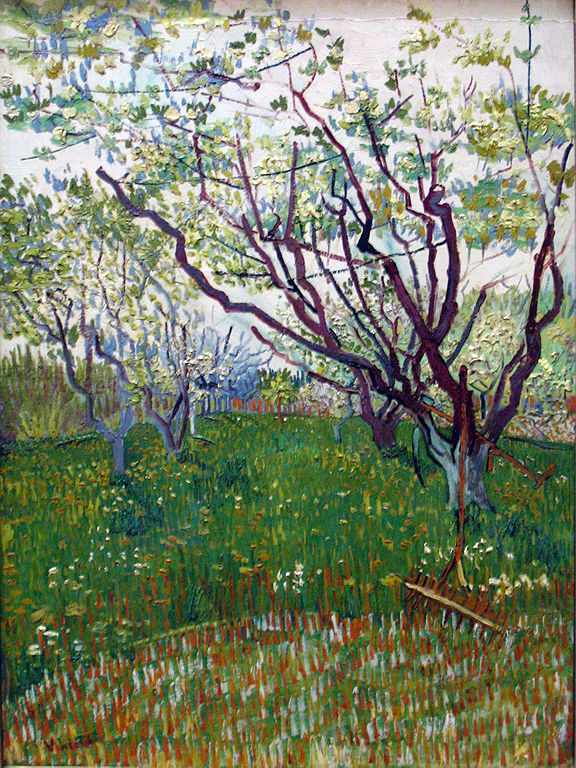
Vincent van Gogh, “The Flowering Orchard”; 1888; Metropolitan Museum, New York; courtesy of commons.wikimedia.org

There is a sense of satisfaction in planting a tree. Usually it will be around far longer than the planter. The oak that Shelley planted as a child at his family home became a memorial. People still collect leaves from trees near Tolstoy’s grave, trees that shaded him on his walks through Yasnaya Polyana. There are good reasons for planting trees. Even a Tolstoy had to be reminded of life’s brevity. Planting a tree that will shelter our grandchildren, and theirs, can silence us before a vast and timeless nature, so still, so much more in touch with the timeless than busy people.

Read the rest of this article »

Restoring Our Future

by Winin Pereira and Jeremy Seabrook

The other day there was a report in the news about a little girl in Bombay who had never seen a live butterfly. There must be something drastically wrong with the way we have organised our lives, or the way it is organised for us, to have resulted in our exchanging the beauty of butterflies on the wing for a handful of hi-tech trinkets. The relationship between our internal environment, (human appetites) and the external one (the planet) has to be reconstructed around a less damaging and ruinous relationship.

Traditional Respect for the Earth

The ancient sages discerned a principle of harmony pervading the entire universe. Each individual forms part of all other life and non-life, one with the earth. This concept requires respect for all that surrounds us, since the individual self merges with the rest of creation. Such a perception can form the basis for a just, sustainable society.

Read the rest of this article »


hrule
“When planted in the garden, the mustard seed, smallest of all the seeds, became a large tree, and birds came and made their home there.” Luke 13:19

“For me whatever is in the atoms and molecules is in the universe. I believe in the saying that what is in the microcosm of one’s self is reflected in the macrocosm.” M. Gandhi
