by Arne Naess
It was Gandhi’s claim that the greater the efficiency he acquired in the use of nonviolence, the greater the impression nonviolence made on his opponents. This claim he held to be a legacy of his experiences in South Africa. Was he right in this? Did his claim follow, according to inductive principles, as a valid conclusion from what he saw?
The railway-strike episode and others of a similar kind did, in fact, provide Gandhi with an empirical basis for the hypothesis that the more he applied, even to fanatical extremes, the principle of nonviolence, the greater was its effect, and that every increase, no matter how slight, in the purity of the application of the principle meant an increase in the chances of success. Thus we can see what was meant by Gandhi’s seemingly extreme claim that if one man were able to achieve an entirely perfect, nonviolent method, all the opposition in the world would vanish. Yet we must be careful to note that Gandhi explicitly stated that we are all more or less imperfect, not least himself, and that therefore we can talk only in terms of degrees of success and not perfection.
Read the rest of this article »
by Arne Naess
Some of Gandhi’s fellow-workers, just as some of Nehru’s in a later day, were Socialists and Marxists. Though critical of their views, Gandhi was far from negatively disposed toward their aims. He believed, however, that it could not be in the employer’s interests to behave badly toward the workers, and that the employer could be persuaded to make radical reforms. On the basis of psychological and social interests common to both sides, he believed it impossible, in the long run, for one group to profit at the expense of the other. Exploitation and oppression amounted to violence, in Gandhi’s terms, and could only drive participants apart.
Today we might well admit that the acceptance of Gandhi’s view could have spared us Lenin’s uncritical acceptance of means and also the kind of laissez-faire liberalism we find in Western Europe, a liberalism which rejects all measures of economic control to remedy the undeserved suffering of the poor. We have seen in our time how both of the political philosophies from which these economic views are derived have led to violence and oppression.
Read the rest of this article »
by William J. Jackson
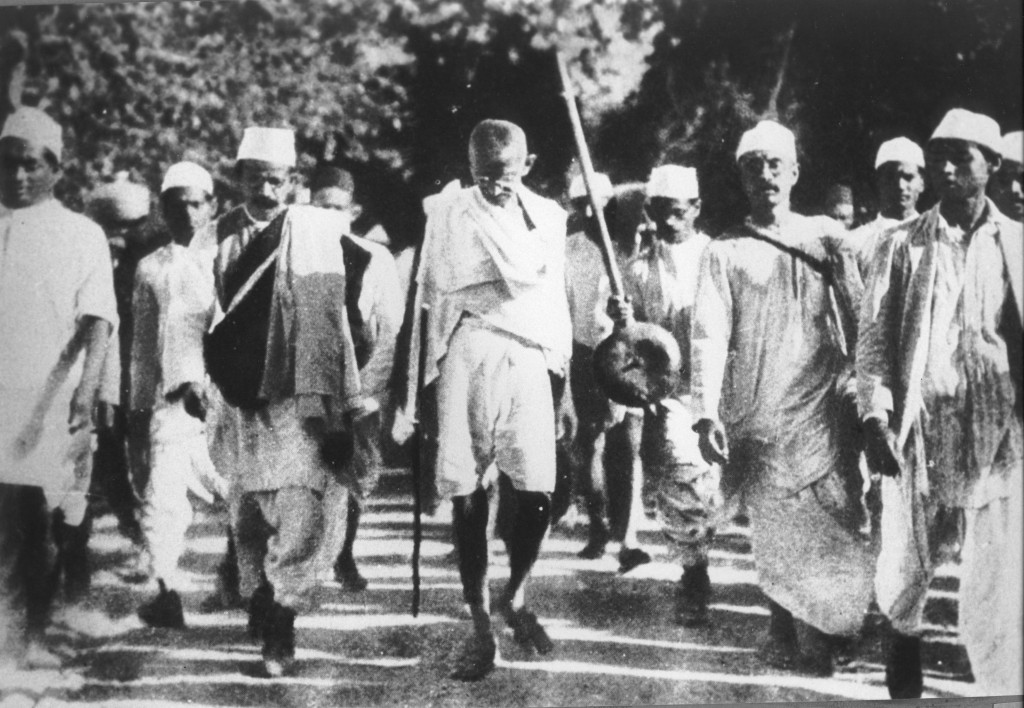
Gandhi on the Salt March, 1930; public domain photo; photographer unknown
The image of Gandhi in action, walking with a staff in his hand, is well known. We see it in newsreels, statues, films and photos. Thomas Merton described Gandhi as a human question mark. Perhaps we should amend that to “a walking human question mark” moving across the landscape. He was a man on the move, inquiring why injustices exist and how to remedy them.
When Gandhi returned to India after being away for years studying in England and practicing law in South Africa, he tirelessly traveled all over the subcontinent. He went to places where he was invited to resolve conflicts, and was constantly taking the pulse of the people of India, assessing their needs and views, diagnosing the nation’s ills, and, when possible, trying to address them with his legal expertise. During much of this period he traveled by trains in third class cars.
Read the rest of this article »