by Lloyd I. Rudolph
My title is figurative, not literal; Gandhi never set foot on American soil. His presence is the result of American responses to his person, ideas, and practice. For most Americans, they were exotic, often alien, fascinating for some, threatening or subversive to others. This chapter analyses America’s reception and understanding of Gandhi by pursuing two questions: Is he credible’? Is he intelligible?
For a person to be credible, it must be possible to believe that this seemingly quixotic person is someone like ‘us’: someone who makes sense in terms of America’s cultural paradigms and historical experience. From the beginning many thought that Gandhi was putting ‘us’ on, that he was fooling us while fooling around. Was he for real or was he a fraud?
Read the rest of this article »
by Thomas Merton

It would be a serious mistake to regard Christian nonviolence simply as a novel tactic which is at once efficacious and even edifying, and which enables the sensitive person to participate in the struggles of the world without being dirtied with blood. Nonviolence is not simply a way of proving one’s point and getting what one wants without being involved in behavior that one considers ugly and evil. Nor is it, for that matter, a means which anyone legitimately can make use of according to his fancy for any purpose whatever. To practice nonviolence for a purely selfish or arbitrary end would in fact discredit and distort the truth of nonviolent resistance.
Read the rest of this article »
by John Dear
Like all of you, Thomas Merton has been one of my teachers, and it’s a blessing to reflect on his exemplary life and astonishing witness.
I’m 45, have been in the Jesuits almost 25 years now, went to college at Duke University, decided one day that I really did believe in God and that I wanted to give my whole life to God, and the next thing you know, I was entering the Jesuits. I’m still trying to figure out how that happened! Before I entered the Jesuits, I decided I better go see where Jesus lived, so I decided to make a walking pilgrimage through Israel, to see the physical lay of the land, only the day I left for Israel in June 1982, Israel invaded Lebanon and I found myself walking through a war zone.
Read the rest of this article »
by John S. Moolakkattu
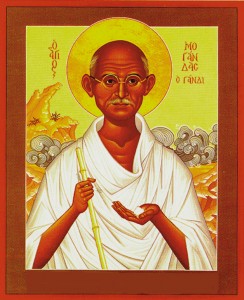 “Mohandas Gandhi of India”;
original icon by Robert Lentz;
thanks to Trinity Stores
Is Gandhi a human ecologist? If we go by the ideas generated by the environmental movement in India, which is strongly influenced by Gandhi, the answer is a definite ‘yes’. But Gandhi’s place in the ecological movement is yet to be established on a secure footing internationally. Even the recent Encyclopedia of Human Ecology edited by Julia R Miller et al. (2003) omitted Gandhi as one of its entries in its otherwise impressive list. Ecological consciousness, understandably, is a phenomenon that gained momentum only in the last four decades or so. But the roots of it can be traced to worldviews, traditions, culture, religion and folklore. Ecology is the science that focuses on the relationships between living organisms and their environment. Human ecology is about relationships between people and their environment. Human activities impact on ecosystems. Conversely, ecosystems are strongly influenced by the social system in which people live. Our worldview both as individuals and as society shapes the way we formulate our strategies for action (Marten 2001).
Read the rest of this article »