Archive for January 2014

Give Nonviolence a Chance in Syria

by Amitabh Pal

A nonviolent movement survives in Syria. Overshadowed by violence on both sides and ignored by the media, activists are still peacefully defying the Syrian regime.

Pacifism has a long lineage in Syria. One of the foremost philosophers of nonviolence in the Muslim world, Jawdat Said, is Syrian. The octogenarian, sometimes referred to as the “Syrian Gandhi,” is renowned for his attempts to conceptualize Islam as a pacifist religion. Using the parable of Cain and Abel (narrated in the Quran, too), Said urges Muslims to take their lead from the Prophet Muhammad (who cited Abel approvingly a number of times) and embrace “The Doctrine of the First Son of Adam,” the title of his most famous book. Said has been jailed a number of times since his work became publicly known in the 1960s. After spending six months touring the United States and Canada last year, he returned to Syria in an attempt to keep the flame of peace alive in his country.

Read the rest of this article »

The Syrian Revolution: Nonviolent Resistance and the Ensuing Armed Struggle

by Mohja Kahf

Logo of Syrian Nonviolence Movement; artist unknown; courtesy of SNM

Editor’s Preface: Syria commands the news daily, no less the atrocities of war committed there. Dr. Mohja Kahf’s courageous and comprehensive article chronicles an alternate, nonviolent resistance, overlooked or suppressed in the media. Since 2011, Quaker groups such as Friends for a Nonviolent World, have been “supporting Syrian nonviolent organizations and activists in their struggle for freedom, justice, inclusiveness, and democracy.” By 2012 the nonviolent movement was eclipsed by the armed struggle, but nevertheless carries on. If there are rebel groups with whom the UN can negotiate, there is also a nonviolent movement that can and must be engaged. The toll in Syria has been staggering and tragic. Now more than ever the efforts and courage of nonviolent resisters need also be supported and their stories told. JG

The Syrian uprising sprang from the country’s grassroots, especially from youth in their teens, and adults in their twenties and thirties. They, not seasoned oppositionists, began the uprising, and are its core population. They share, rather than a particular ideology, a generational experience of disenfranchisement and brutalization by a corrupt, repressive, and massively armed ruling elite in Syria.

The Tunisian and Egyptian revolutions were empowering models for these Syrians. The uprising is characterized by wide geographic spread, significant rural and small-town involvement, and a basis in local communities organizing around local grievances, as well as in solidarity for each other. The protest movement did not mobilize around religious identity, showed a fundamental respect for the diversity of Syria, and included minority participants.

The Syrian uprising began nonviolently and the vast majority of its populace maintained nonviolence as its path to pursue regime change and a democratic Syria.

The uprising began nonviolently and the vast majority of its populace maintained nonviolence as its path to pursue regime change and a democratic Syria, until an armed flank emerged in August 2011. The Syrian Revolution has morphed. From midsummer to autumn 2011, armed resistance developed, political bodies formed to represent the revolution outside Syria, and political Islamists of various sorts entered the uprising scene. Since then, armed resistance has overshadowed nonviolent resistance in Syria.

Read the rest of this article »

On Islamic Nonviolence

by Rabia Terri Harris

“Peace”; logo of Muslim Peace Fellowship; courtesy of MPF

Nonviolence is one of the most misunderstood words in the English language, and one of the most misunderstood ideas in the world. This confusion is not surprising, since the word means two things at the same time. And the one idea behind both meanings, though very simple, is not easy. It goes against the way many people think.

Here are the two different meanings of nonviolence.

Nonviolence is the life decision to live in harmony with the order of creation by giving up the domination of other people or the planet. Today, when put into community practice, this life decision is called culture of peace or peace-building.

Read the rest of this article »

Martin Luther King: Nonviolent Insurrection for Economic Justice

by Terry Messman

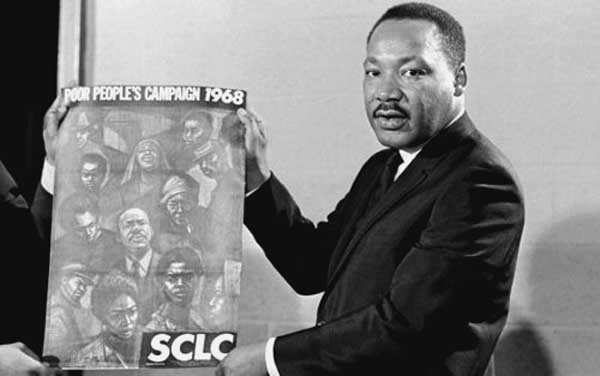
Martin Luther King, Jr.; with poster for Poor People’s Campaign; photo by Horace Cort; courtesy AP

Sometimes, in the midst of protest marches, a feeling springs up unawares, a feeling that Martin Luther King’s last dream can never die. His visionary dream of a Poor People’s Campaign remains an unsurpassed blueprint for the edifice of human rights we are still waiting to construct, the resurrection of the Dream.

For many years, everyone from well-meaning educators to White House officials has called on Americans to honor the spirit of Martin Luther King, Jr., by volunteering in community projects such as fixing up schools and community centers, removing graffiti and collecting food. These various proposals for a day of volunteerism to honor the civil rights leader fall tragically short of King’s dream of economic and racial justice, and an end to war. For, in his last days, Martin was on the move to Washington, D.C., not to participate in a feel-good photo-op at some community renovation project, but rather to launch a showdown with the federal government — a government that, even under the leadership of liberal Democratic Presidents Kennedy and Johnson, had refused to remove the burden of poverty from the backs of the poor.

Read the rest of this article »
Some Thoughts on Darwin, Gandhi, and Einstein

by B.D. Nageswara Rao

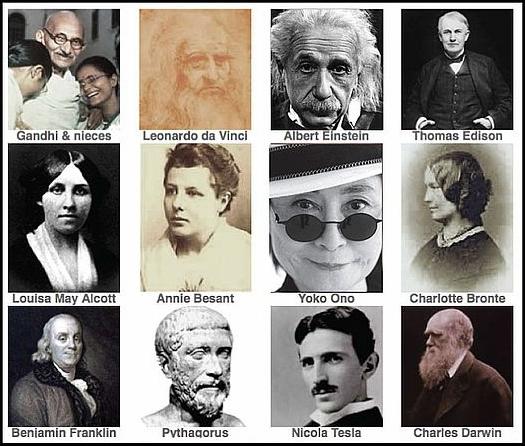
“Famous Vegetarians”; artist unknown; courtesy of herenow4you.net

Abstract

Gandhi’s message of nonviolence, and the methods he devised to practice it, are widely acclaimed to be of historical significance. However, his altruism seems contrary to the central tenet of Darwinism that survival is optimized for those who are adapted to the environment, i.e. those who are best prepared for war have the best chance of survival in a world where disputes are settled through violence. Nevertheless he chose nonviolence as an inviolable constraint in addressing all types of human problems and proclaimed, “While there are causes for which I am prepared to die, there is no cause for which I am prepared to kill.” His formulations of Salt Satyagraha, civil disobedience and non-cooperation movements are striking examples of profound analytical thought analogous (in my view) to Einstein’s formulation of the Special Theory of Relativity. Einstein was confronted with the experimentally proven fact that the velocity of light in vacuum is unchanged in a moving frame of reference. With this inviolable constraint he reformulated the laws of Newtonian mechanics by invoking a previously unthinkable requirement that mass, length and time change in a moving frame of reference, and thereby deduced the principle of mass-energy equivalence (E=mc2). Thus the Special Theory of Relativity was born, and a new era emerged in physics. Gandhi’s principle of nonviolence offered an alternative to war in solving global disputes, and thus ushered in a new era in human history. His message has influenced other reformers around the world, notably Martin Luther King and Nelson Mandela. That it is not widely embraced is an indication of the fact that, functionally, human beings are basically driven by primitive Darwinian pressures generated by the reptilian brain, and have not allowed themselves to be persuaded adequately by the capabilities of the human brain which gave rise to ethics, altruism, and egalitarianism in our societies.

Read the rest of this article »

Guest Editorial: Ethical and/or Strategic Nonviolence

by Sean Chabot

Editor’s Preface: An article by Nathan Schneider, which we posted 9 January, drew attention to a controversial essay by Sean Chabot and Majid Sharifi, which we also posted on the same day. Nathan’s article drew a flurry of comments, which bear consulting at this link, and to which Sean Chabot responded. Sean was also kind enough to answer some of our own questions and all of his comments have been edited into the following Guest Editorial. JG

First of all, I want to say that I am grateful to all those who have commented on the article I co-authored with Majid Sharifi, thus initiating a dialogue with critics as well as supporters. It is by sharing our relative (and therefore inherently flawed) glimpses of truth that we improve our individual and collective experiments with truth. I will try to reference the main disagreements and agreements in the hope of providing further clarity.

Read the rest of this article »

“Dictators Don’t Like Us”: The Progressive Interview with Gene Sharp

by Amitabh Pal

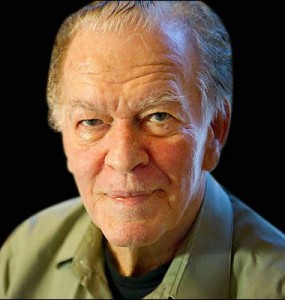
Gene Sharp, 2012; photographer unknown; courtesy of tarata21.com

Gene Sharp is perhaps the most influential proponent of nonviolent action alive. His work has served as a how-to manual for activists in a swath of countries across Eastern Europe and Asia. For instance, From Dictatorship to Democracy and The Politics of Nonviolent Action helped inspire the Serbian student movement that toppled Slobodan Milosevic in 2000.

Sharp writes, “Nonviolent action is possible, and is capable of wielding great power even against ruthless rulers and military regimes, because it attacks the most vulnerable characteristic of all hierarchical institutions and governments: dependence on the governed.”

Sharp drafted From Dictatorship to Democracy at the invitation of a Burmese activist. He was smuggled into Burma to assist in courses on nonviolent struggle for those resisting the military regime. He was in Tiananmen Square shortly before the tanks started rolling in. He has traveled to Israel and Palestine a number of times to disseminate his ideas. He was also invited into Latvia, Lithuania, and Estonia, this time by the governments themselves. He consulted with ministers on the nature and requirements of the campaign that they were using to peacefully secede from the Soviet Union. The three governments also used as a guide his book Civilian-Based Defense. The three countries became sovereign with almost no loss of life.

Read the rest of this article »

The Violence of Nonviolence: Problematizing Nonviolent Social Movements in the Middle East

by Sean Chabot and Majid Sharifi

We vividly remember our hopeful sentiments upon witnessing thousands of unarmed people taking to the streets in the Middle East, starting with Iran’s Green Movement in June 2009 and culminating with Egypt’s uprising in January 2011. Like others, we felt heartened by the promise of nonviolent social movements in countries with populations that have long suffered from oppressive domestic governments and destructive foreign interventions. Soon, though, we realized that the people’s courageous struggles were in danger of perpetuating, rather than transforming, the human relations and global paradigm at the root of their suffering. We feared that promising manifestations of nonviolence would end up reproducing various structures and forms of violence. Unfortunately, we were mostly right in both cases. Although the Green Movement displayed the Iranian population’s capacity for resistance in the face of repressive domination, it did not bring down the Ahmadinejad government or contribute to improved social and economic conditions. And while Egyptians successfully overthrew the Mubarak regime, they eventually brought to power a president and a political party that have failed to enhance the quality of life and dignity of poor people in Egypt. What happened?

Read the rest of this article »

Guest Editorial: Where Gene Sharp Departed from Gandhi, and Where it Leaves Us

by Nathan Schneider

Gene Sharp collage; artist unknown; courtesy of Socialistplatform

There is something of a genre of critique, one sometimes lobbed at Waging Nonviolence, which considers the discourse of nonviolence to be wholly subservient to the U.S. foreign policy interests, and/or the CIA specifically. It’s a line of attack that has generally baffled us, since anything worthy of the name “nonviolence” would certainly run counter to the doings of the largest and most pervasive military machine in the history of the world. Occasionally there seems to be some truth in these critiques, but it’s hard to know where that begins and the conspiracy-theory nonsense ends.

Now I think I know where to begin to draw the line. The reason is a new paper published in the journal Societies Without Borders in September by Sean Chabot and Majid Sharifi. It’s called “The Violence of Nonviolence: Problematizing Nonviolent Resistance in Iran and Egypt.”

Read the rest of this article »

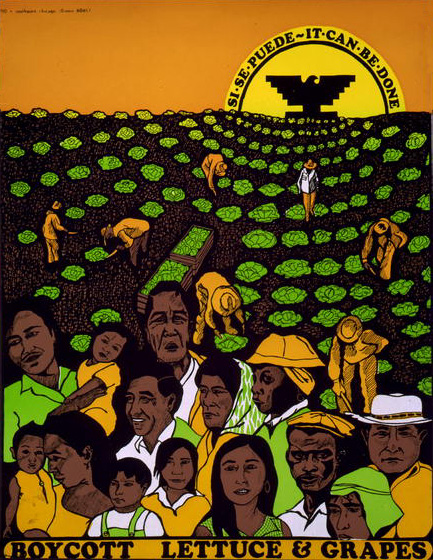
Workers on the Land: The Grape Strikers in Delano

by Jeff Rudick

Editor’s Preface: In 1970, the year this article was written, the Catholic Worker Farm was in Tivoli, New York, not far from Bard College, a highly regarded liberal arts institution, as it still is. Indeed Bard was close enough for students to walk to the farm, and not only did many do this regularly, but some came to live at the Worker summers and holidays. The poet and theater director Jeffrey Rudick was one such student, and a valuable addition to the community. He was  “looking for a project” and Dorothy encouraged him to “get yourself to Delano and write about it for the paper”, as he recalls her saying. The Worker could be said to have “raised the social consciousnesses” of many generations of students, not just those from Bard. JG

Poster c. 1970, artist unknown; courtesy of University of Michigan

I joined the strikers in Delano, now well into their fifth year of a frustrating battle, for little more than five weeks, and hardly claim to know in a real way what their hardship was. But my impressions from the experience were and are strong and lasting, and I would like to share some of them.

I bussed up from Bakersfield to Delano through the flat commercial roads interspersed with long rows of vines. Delano appeared an ugly flat monotonous town devoid of woodland, crammed with the commercial clutter that plagues the landscape of America. I was later to learn that the railroad, which slices through the town, the planted orange trees and palms, and the long fields of vines on the outskirts were the only pleasing diversions for the eye.

As I sat on the bench in front of the small Greyhound station, I felt increasingly defensive. Many drivers in the traffic I was watching turned their heads and eyed me suspiciously as they passed by. I became conscious of my long hair as in so many small towns; I wondered if they knew I had come to join the strikers. I stepped into the nearest phone booth and leafed through the book for the number of the strikers’ headquarters. It was nearly dark and the last rays of the setting sun were fading, a dark shadow of rusted red becoming more prominent, until, as I reached the U’s there was a large red blotch as of crusted blood over the United Farm Workers’ listing.

Read the rest of this article »


hrule
“When planted in the garden, the mustard seed, smallest of all the seeds, became a large tree, and birds came and made their home there.” Luke 13:19

“For me whatever is in the atoms and molecules is in the universe. I believe in the saying that what is in the microcosm of one’s self is reflected in the macrocosm.” M. Gandhi